MAJOR THREATS TO WILDLIFE IN IRELAND AND AREAS TO FOCUS CONSERVATION ACTIONS

(A study I did in 2022 while studying for the MSc in World Heritage Conservation at UCD, still relevant in 2025)

INTRODUCTION
This report will endeavour to introduce the International Union for Conservation of Nature and Natural Resources (IUCN) and the IUCN Red List they established to identify the species in danger of extinction in the world and the threats that they face while also being a tool for conservation action. It will then examine the threats to species in Ireland as per the IUCN Red List, identify which are the major threats for Ireland and suggest what areas to focus conservation actions on.
IUCN
The first International organisation established with the protection of Nature in mind, in 1922, was the establishment of the International Council for Bird Preservation and later renamed Birdlife (Holdgate, 2013). Then the International Union for the Conservation of Nature and Natural Resources (IUPN) was established in 1948 with the backing of the United Nations Educational, Scientific and Cultural Organisation (UNESCO) with very few resources and was initially set up as a meeting space and support for its members rather than an agency (Holdgate, 2013). It aimed to share information among members and in that way make a strong nature conservation movement. It later became the International Union for Conservation of Nature and Natural Resources (IUCN), sometimes referred to as the World Conservation Union (Holdgate, 2013). The IUCN is a unique entity in that the purpose of advancing sustainable development with the hope of creating a just world that conserves and values nature has given this institution the important role of bringing governments and civil society together with one purpose (Our Union, 2022). It has over 1,400 Member Organisations spanning States, government agencies, NGOs, scientific and academic institutions, indigenous groups, and businesses. Over 15,000 scientists and experts, in the UCN expert Commissions, provide knowledge and policy advice to its members (Our Union, 2022).
IUCN REDLIST
The IUCN Red List of Threatened Species was established in 1964(The IUCN Red List of Threatened Species, 2022). It is more than a databank of species, it is the information source on the global extinction risk of these species which include animal, fungus, and plant species (The IUCN Red List of Threatened Species, 2022). It is a critical indicator of biodiversity health and a powerful tool for change in policy and conservation action and is used across the globe by governments, NGO’s, environmental groups, educational organisations, business communities, and more to monitor population size and range, habitat and ecology and threats, actual and possible actions (The IUCN Red List of Threatened Species, 2022). It is compiled by the IUCN Global Species Program staff, experts, and organisations in the IUCN Species Survival Commission and partner networks (The IUCN Red List of Threatened Species, 2022). The aim is to create a more complete ‘Barometer of Life’, increasing the number of species assessed to at least 160,000 in order to assist the world in reversing the decline in biodiversity (The IUCN Red List of Threatened Species, 2022).

IUCN REDLIST IRELAND
The IUCN provide guidelines to produce RED lists at regional level and Ireland has
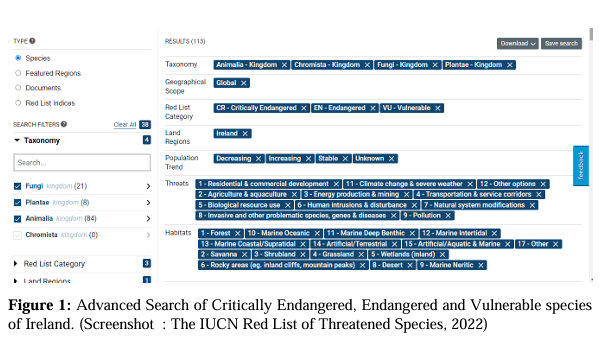
adopted these guidelines (Publications – Red Lists, 2022). The National Biodiversity Data Centre (NBDC) has also published a national standard for producing Ireland’s Red Lists. These lists are prepared with the guidance of the National Parks and Wildlife Service (NPWS) in the Republic and the Northern Ireland Environment Agency (NIEA) in Northern Ireland. So far thirteen lists are available (Publications – Red Lists, 2022). These lists don’t necessarily match with the IUCN Red List, which is based on Global Data, what might be critically endangered on a global scale may not be on a national scale and vice versa so using both as guidance for conservation actions would be ideal however for the scope of this report the actions recommended will be based on the IUCN Red List for Ireland. As per Figure 1, the search used was limited to Critical Endangered (CR), Endangered (EN), and Vulnerable (VU) species of Ireland resulting in 113, with a breakdown in the taxonomy of 21 from the Fungi Kingdom, 8 from the Plantae Kingdom and 84 from the Animalia Kingdom.
MAJOR THREATS TO WILD SPECIES IN IRELAND
To identify the major threats to wild species a table was created from the search of all the data for each threat listed and the Animalia Kingdom was categorised in more detail into Mammal, Bird, Amphibians, Fish, Reptile, Mollusc and Insect (Table 1).
Table 1: Analysis of Threats to Species on the Red List, Ireland.

From this information it is evident that there are a significant number of threats to several varied species but that groups of species and sections of threats could be extracted from it to focus on for consideration of conservation actions as one threat affected many species and many of the sub threats were affecting the same species.
For example, taking pollution, or agriculture & aquaculture with all the sub threats under those headings and addressing them would benefit species across the board. Reviewing the results from the search based on this information it was noted that the mammals were all sea mammals that would be impacted by actions decided on for sea fish except for the European Rabbit which is currently not endangered in Ireland though it is on mainland Europe and while they should be monitored there may be other areas to concentrate on that will have a higher impact. It was also noted that while Amphibians have no endangered listing on the Global IUCN Red List for Ireland the Natterjack Toad is listed as Endangered on the National List (King, Marnell, Kingston, 2022). Once conservation actions based on information from the IUCN Red List are established it may also be beneficial to examine the 13 Red lists completed nationally. It will also be beneficial when detailing actions to have the sub threats and to note which ones are the most significant and therefore more urgent, but the main information is easier to identify in the compacted Table 2 which has the larger numbers in red.
Table 2: Threats to Ireland’s Species on the IUCN RED List.

In Figure 2 we can see that some species are faring worse, birds (orange), fish (yellow) and fungi (brown), with five main threats standing out – Biological Resource Use, Pollution, Agriculture & Aquaculture (between Energy Production & Mining and Residential & Commercial Development on the chart), Residential & Commercial Development and Climate Change & Severe Weather. Concentrating on Biological Resource Use alone would have a huge impact, however given that Fungi live in so many different environments and are so essential in protecting plant biodiversity and soil health concentrating some actions towards them would impact many other species too and they are heavily impacted by the other main threats identified (Mommer, L., Cotton, T.,Raaijmakers, J.M., 2018).

Figure 2: Threats to Ireland’s Species on the IUCN RED List. (Modified from Source:
The IUCN Red List of Threatened Species, 2022)
Having identified five main threats a chart (Figure 3) and table (Table 3) were created
focusing only on those to further identify which impacts what the most.

Figure 3: Largest Threats to Ireland’s Species on the IUCN RED List. (Modified from
Source: The IUCN Red List of Threatened Species, 2022)

These show that fish are mostly affected by Biological Resource Use and Pollution, the threats to concentrate on for Fungi are Residential & Commercial Development,
Agriculture & Aquaculture, and Pollution, and looking at conservation actions in the areas of Biological Resource Use, Pollution, and Climate Change & Severe Weather would benefit the bird population most.
Table 3: Largest Threats to Ireland’s Species on the IUCN RED List.

NECESSARY CONSERVATION ACTION TO ALLEVIATE THREATS TO WILD
SPECIES IN IRELAND

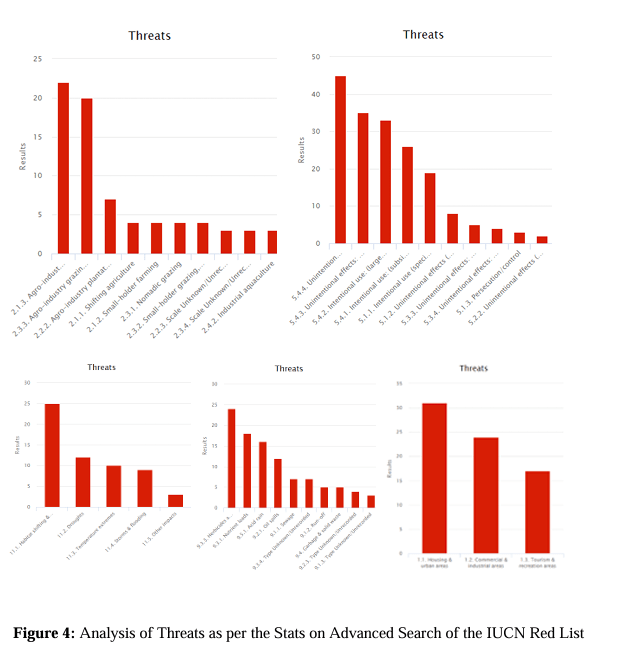
Based on the above assessment of threats the most important areas on which to focus conservation actions for Ireland, are reducing the five threats in table 3 for the 3 species groups of Fish, Fungi, and Bird. It is assumed that the many other species also affected by these threats would also benefit from conservation actions taken based on the spread in Table 1. Reducing the search criteria to just include these main threats on an individual basis gave access to further stats on the IUCN Red List Search (Figure 4) which will assist in the analysis and actions needed process as it shows us the main focus points in each threat, the reference number are as per their references on the IUCN Threats listing:

  • 5 – Biological Resource Use
    Per Figure 4, page 11, there are four substantial threats under 5.4: Fishing and
    Harvesting Aquatic resources as follows in order of severity.
    o 5.4.4 Unintentional effects: (large scale) harvest
    o 5.4.3 Unintentional effects: (subsistence/small scale) harvest
    o 5.4.2 Intentional use: (large scale) harvest
    o 5.4.1 Intentional use: (subsistence/small scale) harvest
  • 9 – Pollution
    Per Figure 4, page 11, the two largest pollution threats are under 9.3 Agricultural and Forestry Effluents.
    o 9.3.3 Herbicides and Pesticides (24)
    o 9.3.1 Nutrient Loads (18)
  • 1 – Residential & Commercial Development
    There are three subcategories on the IUCN Red List under this and all are relatively high.
  • 1.1 Housing and Urban Areas (31)
  • o 1.2 Commercial and Industrial Areas (24)
  • o 1.3 Tourism and Recreational Areas (17)
  • 2 – Agriculture & Aquaculture
    Per Figure 4, page 11, two threats are substantially larger than the others in this category.
    o 2.1.3 Agro Industry Farming (22)
    o 2.3.3 Agro Industry Grazing, Ranching or Farming (20)
  • 3 – Climate Change & Severe Weather
    Per Figure 4, page 11, one threat stands out among the many climate change threats.
    o 11.1 Habitat Shifting and Alteration (25)

Just by focusing on the results shown from Figure 4, page 11, as outlined above there are clear areas to focus on but with 113 listed species of vulnerable, endangered, and critically endangered just a few were assessed in more detail given that many face the same threats and the same conservation actions could be applied :

  • Fish
    o Biological Resource Use – There are intentional and unintentional threats during the harvest of fish inland and at sea, both at the commercial level and the subsistence level, however, there is a small hierarchy of threats with
    unintentional threats over intentional and also with commercial over
    subsistence so the initial focus should be on the practices and reducing the
    unintentional threats.

Reading through some of the fish on the Red List lessons can be learned and actions that worked used for others. The Common Blue Skate is Critically Endangered Globally, and the population is still decreasing however there have been a number of fishery-independent trawl surveys since EU fisheries regulations listed it as a prohibited species which may be allowing population growth. Therefore, if all the fish that are Vulnerable, Endangered or Critically Endangered were listed as prohibited the “unintentional” harvest should in theory decrease as more care is taken (Ellis, McCully-Philipps, Sims, 2021).
Proposed Conservation Action: Regulation, listing species as prohibited.

Using the same example, it is a general practice among recreational anglers in the UK and Ireland to return live skates. Many also recording, tagging, and releasing their catches (Ellis, McCully-Philipps, Sims, 2021) .

Proposed Conservation Action: Educate and Inform Recreational Anglers and encourage their participation in the conservation process of recording and tagging.

Using another example from the Red List, the Freshwater Pearl Mussel shows how so many threats can be there at one time, it faces most of the threats outlined in Figure 4 and more besides. While it is an extreme example, the threats it faces affect the other listed fish and species and the conservation actions that could be taken for it will apply also. (Cordeiro, Seddon, Moorkens, 2017). Sediment accumulation in the riverbed seems to be the largest threat and that can occur from agricultural practices, residential and commercial development, pollution and climate change. It
reflects what is now becoming more and more apparent in Ireland, more than half of our waterways are not well. According to the Sustainable Water Network of Ireland (SWAN) there are a number of causes, which tie in with the threats to fish from the Red List and Industrial Agriculture is the most significant – fertilisers, slurry, drainage and the destruction of habitats. Residential and Commercial Development adds to that with dredging, drainage and waterside development and so on (SWAN, 2022).
Proposed Conservation Action: Increase the number of designated Special Areas of Conservation (SAC), Education and Awareness, Encourage reporting of pollution, Visible action and enforcement of laws already in place, incentivise more sustainable agriculture practices.

Fungi
o Most of the Fungi listed are listed as vulnerable but more study is needed. They also come from varied habitats, those near waterways are susceptible to many of the same threats as fish and much of the same conservation actions are required. The Felted Pinkgill is found in semi -natural grassland to subalpine areas of Europe and Russia and is a good example for a wider selection (Jordal, 2019). The intensification of industrialised agriculture practices, development projects, and pollution (airborne nitrogen deposition have impaired the habitat of this fungi and the population is decreasing (Jordal, 2019).
Proposed Conservation Action: Many of the actions proposed regarding the Pearl Mussel would apply and as suggested on the Red List site payment for conserving should be considered an option and site management is also key (Jordal, 2019).

Birds
o The European Turtledove was chosen as an Inland example because it is not obscure as some other examples may be and is antidotally spoken about with love and nostalgia so could be used as a mascot species perhaps. It is vulnerable and undergoing rapid decline due to similar threats mentioned in previous examples (Hermes, 2019). The change in agriculture practices has impacted this bird, and many more, mainly by the loss of habitat, hedgerows and areas of scrub being destroyed in the name of larger pasture and monocrop land. Spraying of herbicides have added to their decline. They have reduced food supplies and nesting grounds. Less hedgerows and trees in urban areas have also seen their decline there (Hermes, 2019).
Proposed Conservation Action: Many manageable actions have been outlined starting with further gathering of information, mapping migration routes, manage known habitats, educate and encourage farmers and others to maintain hedgerows and breeding grounds and scrubland for wildlife (Hermes, 2019).

A seabird that is much loved by all and very recognizable even more so perhaps than before due to a creature in the StarWars movies being inspired by it and an animation program, Puffin Rock, being built around its “cuteness” is unfortunately also meeting the criteria for being listed as Vulnerable, (Birdlife International, 2018). This bird is being threatened by some of the aforementioned threats but is in particular vulnerable to climate change; changes in sea temperature, loss of food, changes in hunting habits of marine and terrestrial predators, extreme weather all of which reduce breeding and increase mortality rates (Birdlife International, 2018). Humans are adding to the risks with overfishing of the prey of the Puffin, introduction of invasive species predators such as mink, windfarms, oil spillages. Deaths have been caused by other pollutants and garbage (Birdlife International, 2018).
Proposed Conservation Action: Increase the number of Special Protection Areas and monitor the buffer areas. In the recommendations one that is very achievable is developing codes of conduct for activities such as tourism. Developing regulations and laws, manage fishing and continued monitoring. (Birdlife International, 2018).

SUMMARY OF PROPOSED CONSERVATION ACTIONS

Payment for conserving.

Regulation and Laws.

Listing species as prohibited for fishing and/ot hunting.

Educate and Inform.

Encourage participation in the conservation process of recording and tagging.

Increase the number of designated Special Areas of Conservation (SAC).

Monitor the buffer areas.

Encourage reporting of pollution,

Visible action and enforcement of laws already in place.

Incentivise more sustainable agriculture practices.

Site management.

Develop codes of conduct for activities such as tourism.

Further gathering of information.

Mapping migration routes.

Manage known habitats,

Encourage farmers and others to maintain hedgerows and breeding grounds and
scrubland for wildlife.
(Source: The IUCN Red List of Threatened Species, 2022)

CONCLUSION
Based on the advanced search carried out on the IUCN Red List for Vulnerable, Endangered and Critically Endangered Species in Ireland 113 were listed in various
taxonomy, The search included all 12 categories of threats and all habitats to catch as many as possible. An analysis of species against the threats was performed to narrow the examination. Five major threats across the three species of Fish, Fungi and Bird were found and a short examination of these found many similar threats and impacts and possible conservation actions that could be recommended. In order to understand what actions could possibly be undertaken some sample species were looked at on the Red List of 113. It was noted that the Global Red List does not always match the national Red Lists and both should be reviewed when considering actions. The common thread of most of the threats was an underlying lack of consideration or understanding of nature in residential, commercial, agricultural and aquacultural practices. Humans are “Doing without Considering”. There also seems to be a lack of understanding of the links between the natural world and our own human world. Knowledge in biodiversity, ecology, permaculture, sustainable living, working and farming and a holistic view of the world would remedy many of the illnesses of this world and should be part of every decision making process. Many of the actions identified reflect a holistic approach and where they are not applied regulation, legislation and monitoring are needed. The IUCN Red List is not complete, in order to be more effective more research of species is required and if the general public, commercial bodies and agricultural entities are encouraged to take part in completing some of that work they will be more connected to the Barometer of Life and mindful of its fluctuations.

The dream of the UNESCO Biosphere Reserve of the Mid Shannon Biosphere & Environs

Introduction
The people of the Midlands in Ireland have had a tempestuous relationship with the bog since the time of legends. In Tochmarc Étaíne, or The Wooing of Etain, the human king Eochaid demanded of the Tuatha De Danann prince Midir a road over a bog that no man had trodden on before and his spy saw all the men of the world raising a tumult by putting a full forest, clay and stone in the bog (CELT, 2005). Midir said it was too much to have asked of him and put a defect in the trackway (CELT, 2005). There is one such Togher, or Iron Age road, circa 148 BC, on display in the OPW Visitor Centre at Corlea, Kenagh, Co. Longford that has a defect and is thought to have lasted only about ten years as a working causeway (Heritage Ireland, 2023). This story and archaeological find both indicate a long cultural heritage of the peatlands of the Midlands which continued to be exploited for the use of man throughout history. The potential future UNESCO Biosphere Reserve of the Mid Shannon Biosphere & Environs has many protected areas within and around the site along with the cultural history from Iron Age to the age of Bord na Mona. While it is currently degraded in many areas due to 70+ years of industrial extraction some endangered species are taking refuge there and the inspiration of the accidental man-made creation of a nature reserve on Bull Island within the Dublin Bay Biosphere Reserve indicates a vibrant living biodiverse future for the area (Dublin Bay Biosphere, 2023). Therefore, although not yet established as a UNESCO Biosphere Reserve it is an equivalent protected area of both natural and cultural importance.

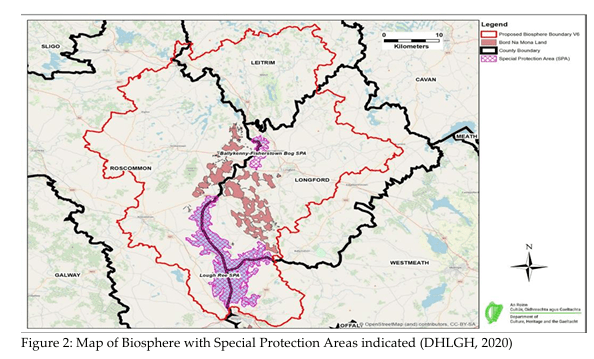
The Mid Shannon Biosphere & Environs is an ambitious but achievable dream. While it isn’t recognised as yet as a UNESCO biosphere region it has been discussed, proposed and planned since 2013 when Longford County Council drafted an initial plan for the Mid Shannon Wilderness Park to include areas of Lough Ree, the Rivers Shannon, Inny and Camlin, the Royal Canal, Newcastle Wood other forests and the then expected to be future rehabilitated Bord na Móna bogs (Longford County Council, 2013). It proceeded to presentation at partner local authorities and to a proposal by the Department of Housing, Local Government and Heritage for a UNESCO Biosphere Reserve as Mid Shannon Biosphere & Environs in 2020 based on the importance of Wetlands for Wildlife, their role in Climate Change & Solutions, the provision of eco-tourism, Carbon sequestration, Education and Awareness/Research (Department of Housing, Local Government and Heritage, 2020). It covers an expansive area of 2,081.87 Sq. Km over four counties (IBID, 2020). There are Special Areas of Conservation (SAC), Special Protection Areas (SPA) and Natura 2000 designated sites in the proposed Biosphere and others in the surrounding area along with Glen Lough a Ramsar site for migrating whooper swans which have also been seen within the boundary (IBID, 2020). See maps of the proposed area in Figure 1 and 2

While the site is of interest for natural heritage and the restoration of bog and habitat it is also in an area of cultural heritage with Corlea Iron Age Trackway, other megalithic and other era sites and can therefore be classified as a mixed cultural/natural site (Heritage Ireland, 2023). It also is linked to the intangible cultural heritage of the Irish Legends of the Mythical Cycle (CELT, 2005).

Conservation
The Burra Charter provides guidance for the conservation and management of places of cultural significance and is based on the knowledge and experience of Australia ICOMOS members (Australia ICOMOS, 2013). Article 1.4 defines conservation as ‘all the processes of looking after a place so as to retain its cultural significance.’ (Australia ICOMOS, 2013). It can also be used as a guide for outlining concerns and conservation strategies for natural and mixed sites. Conservation could refer to :

  • retention or reintroduction of a use;
  • retention of associations and meanings;
  • maintenance, preservation, restoration, reconstruction, adaptation and
    interpretation;
  • retention of the contribution that related places and related objects make to the cultural significance of a place;

It will often be a combination of more than one of these (Australia ICOMOS, 2013).

Conservation Concerns of the Mid Shannon Biosphere & Environs
1 Maintaining/Preserving the SPAs/SACs within the Biosphere and surrounding area.

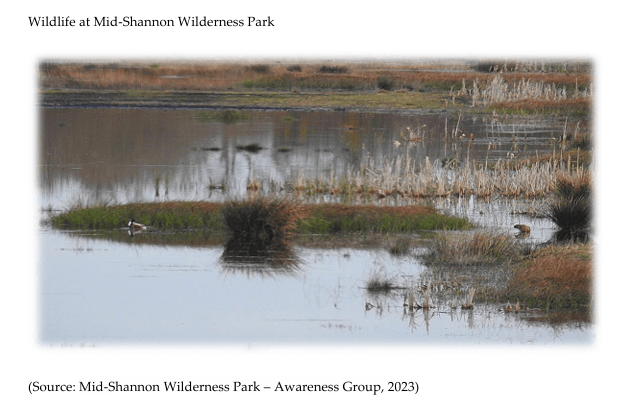
  • Within the context of the proposed Biosphere the conservation of these areas will involve maintaining the conservation objections as laid out by the National Parks and Wildlife Service (NPWS, 2023). At a recent workshop on rewilding hosted by Corlea Trackway Visitor Centre the NPWS Conservation Ranger Sue Moles laid out all that is involved and discussed the plants and bird species of the area. These included wetland birds such as the Curlew – breeding in the area , Red Grouse – a rare sight in the midlands now and none were recorded in Longford at the last survey, the breeding Lapwing – in serious decline, the Corncrake – gone from the midlands, the Greenland White-fronted Goose, the Merlin, the Hen Harrier and the Cuckoo once widespread in the area are also in decline (Moles, 2023). On a positive note the Snipe in rapid decline around the country has found refuge in County Longford and the NPWS has had success breeding Curlew at Lough Ree with successful predator control for the last 8 years (Moles, 2023). This also resulted in more Lapwing, Red-Shank, Ringed Plover, Scoter, Oyster-Catcher, Duck, Sand Piper, Gulls, Little Egrets breeding in the area (Moles, 2023).
  • Sue has worked in the NPWS for 27 years and has been the County Longford Wildife Ranger for 23 years which is quite an extensive area to cover on her own highlighting further concerns with regard to these sites and that is sufficient skilled staff and funding (Moles, 2023).
  • The Report of the Citizen’s Assembly on Biodiversity Loss made a number of recommendations regarding the designated sites and species as they noted they were not sufficiently resourced with staff or funding and should not be regarded in isolation as they are connected to areas outside the sites (Citizen’s Assembly, 2023). A UNESCO Biosphere on the peatlands of the Midlands would help in fulfilling recommendations 131 to 134 on Biodiversity along with the many regarding peatlands specifically (Citizen’s Assembly, 2023).

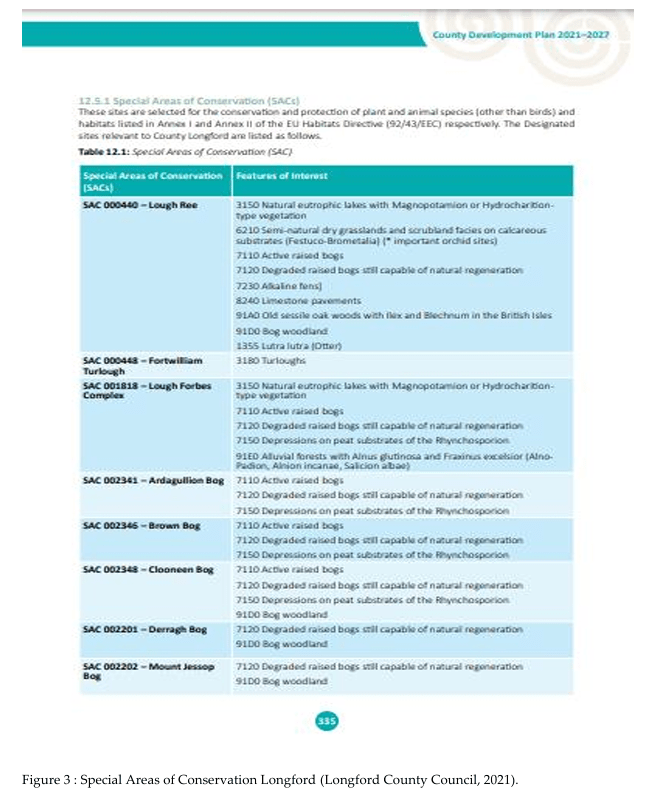
As mentioned there are a number of SPAs and SACs with the area and in the surrounding areas and the maps in Figure 1 and 2 show the remainder of County Longford area is very near the boundary so all of County Longford could be considered important to the Biosphere as could other sites such as Lake Derravaragh of The Children of Lir fame in County Westmeath, a National Heritage Area (NHA) (NPWS,2023). The latest County Development Plan of County Longford considers these areas and the “features of interest” (Longford County Council, 2021). See Figure 3 and 4.

2 Biodiversity Loss is a continuing concern which could be mitigated in Peatlands
by the Reintroduction of Biodiversity through Cessation of Extraction

Scientists have had concern about a biodiversity crisis since they called the first International Conference on Conservation Biology in 1978. The increasingly rapid disappearance of various forms of plant and animal life as well as the destruction of their natural habitats can pose serious threats to human welfare in the future, according to Michael Soule, a conservation biologist at the University of California, San Diego (UCSD, 1978).
The Irish Environmental Protection Agency (EPA) in preparation for a National Peatland Strategy links the health of the peatlands to the health of the waterways and biodiversity (EPA, 2007). It concluded that Peatlands be a priority, management plans be central, and an urgent requirement, for the development of biodiversity policy and noted that conservation also involves restoration of damaged areas (EPA, 2007).

3 Carbon Emissions and Bog Degradation is a concern which can be mitigated by
Restoration Management and Carbon Storage

It is time we start valuing our natural heritage as much as our cultural heritage, start
treating our bogs like our Book of Kells, value our rivers and coastal waters as much
as our multinationals, and cherish our forests as a part of our living history. In doing
this, we can be good ancestors (Ní Shúilleabháín, 2023).

Approximately 70 years of industrial extraction of peat by Bord na Mona has lead to little of the original biodiversity struggling to survive on the outskirts. Other peatland restoration projects, including that at Ardagullion SAC in North Longford (RaisedBogs, 2023) have shown us that the minimum effort of filling the drains and letting nature rewild can be as successful as more intrusive methods. At Ardagullion, circa 800 dams were installed and a 700m barrier dam was installed. The results were almost instantaneous as wildlife returned and rare flora flourished (RaisedBogs, 2023). This approach would also benefit the community in that the people qualified to do the refilling are the people who have been let go from their jobs in Bord Na Mona itself. Studies abroad and in Ireland have shown that degraded peatlands contribute to greenhouse gas emissions – carbon dioxide, methane, nitrous- oxide as well as fluvial losses and restoring and rewetting can substantially reduce emissions (Aitova et Al, 2023). Ireland is approximately 20% peatland so this work would be significant for reducing our emissions (Aitova et Al, 2023).

4 Proposed Windfarm in the centre of the Biosphere is a threat to existing and future biodiversity and the plan for a Biosphere.

This threat to the proposed Biosphere park has the potential to cease the plans completely while undoing the restoration that has already happened. It is also a complete turnaround from what was initially agreed between Bord na Mona and the community (IWT, 2020). When the requirement to shut down all peat extraction was announced Bord na Mona told the community the bogs would be returned to the communities for them to manage and rewild (IWT, 2020). The threat this windfarm poses on the biosphere park is of many parts –
Firstly in order to construct the windfarm the bog needs to be redrained and made dry again and the extra machinery traffic and construction work is an added threat. Bord na Mona has already been draining in the area this despite their initial planning permission being overturned (IWT, 2020) and it is already impacting on the populations of birds, flora and fauna that had reestablished themselves when extraction stopped (IWT,2020). The windfarm will also impact on the birds in the future as the birds who have been re-establishing themselves – whopper swans and cranes are particularly vulnerable to the impact of a windfarm, the activity will also prohibit many other species from re-establishing themselves and it has the added impact on the proposal of a biosphere and all that that would achieve (IWT,2020).

Key attribute that is currently under threat and needs attention
The key attribute that is under threat is the biosphere itself and the biodiversity within if the proposed windfarm is successful (IWT, 2020). As stated above at each stage it is a threat and it is for that reason it was opposed and the planning permission squashed (IWT,2020). It is unfortunate that the community are being ignored. In the report, Ireland’s Just Transition – A report on the perceptions of impacted communities in Ireland, undertaken after the closure of the ESB and Bord na Mona businesses in the area the findings which have been seemingly ignored were :

The people overwhelmingly support the construction of the Mid Shannon Wilderness Park in the area. They feel that the Mid Shannon Wilderness Park would
be a good fit with the communities, that is, economically, environmentally, socially,
and culturally. In terms of energy generation in the area, support for the solar farms
far outweighs the community support for the Derryadd Wind Farm, as the Derryadd Wind Farm is seen as least fitting with local social, cultural, economic, and environmental conditions (UCD Energy Institute, 2020).

It is unfortunate that various experts are taking the view that having the windfarms on the depleted raised bogs of the midlands is the lesser evil to suffer as long as other boglands are protected instead of advocating that all be protected (F. Renou-Wilson and C.A. Farrell ). The community however are not going to give up and will continue to push for the biodiversity of the area and a safe habitat for all, including their families (IWT, 2020).

Conservation Strategy to address the challenges facing this attribute
Four key priorities for the next five years.

  1. To mitigate risks to the key attribute
    Ideally the bogs would be handed over to the communities to take care of them as was initially suggested. They have the landscape and stories embedded in their culture and they are aware of the huge environmental cost that impacted the area for the industrialised peat extraction which employed so many and sustained the local economy. They are prepared to give back to nature in the form of a protected biosphere.
    While this may seem an unlikely outcome there is precedence in indigenous people all over the world managing sites such as the Sami people in Sweden having the majority vote on the management board of the Laponian region (Lindstrand, 2012). The local Irish community also have a tradition with their landscape and a long history of community groups and volunteering together with a love for the area and a need to leave a legacy for their children’s children who when they ask what did you do will be able to see it for themselves.
    If this is to happen communication and cooperation with Bord na Mona and government is key while maintaining a strong stance. Many groups such as Friends of the Earth and The Irish Wildlife Trust are already giving their backing to the community. Petitions to include these bogs in protected zones, to lobby government and EU and inform on the benefits vs the damage could be a start and build on that. The community will possibly need training in environmental activism.
    A Second action for mitigation is to ensure the draining stops immediately. This is ongoing and being ignored by those in authority despite the initial planning permission being squashed. It should have not been happening before and it should have stopped immediately on the decision of The High Court (IWT,2023). The picture below shows the ongoing draining that is pumping the water from bogs at the site of the Shannon Wilderness Park – releasing carbon, polluting water and keeping wildlife away (IWT, 2023)
  1. To ensure the long-term preservation of the site’s attribute(s)
    The proposal for a UNESCO site will need to be moved further along its journey.
    As with other sites and what was planned for this site initially the next step once planning permission is refused and the park is negotiated to be managed by the community in conjunction with Bord na Mona the drains need to be filled in and a walkway that keeps the public from walking on the delicate mosses with viewing platforms can be installed keeping the impact as little as possible at all times. Knowledgeable and trained staff would be required to maintain and protect the area and these would liase with the OPW site at Corlea Trackway and County Longford Wildlife Ranger.
  2. To research and monitor the site’s attribute(s)
    Cooperation between all the partners – the various local authorities, the OPW, Bord na Mona, Longford Wildlife Ranger and establishing ties with networks such as the Community Wetlands Forum, other European and International bodies, third level institutions and secondary schools and the general public will be needed to research and monitor and prepare data on the site.
  3. To advocate best practice in conservation approaches This site has the potential to become a model for the rest of the world to copy which is not an unreasonable aspiration, there are two biospheres in the Republic of Ireland to liase with and there is a body of educated and knowledgeable people many in the community and former employees of Bord na Mona. The community has many experts available to guide the way including County Longford Wildlife Ranger who has been working on the site protecting many breeds of birds, flora and fauna and the OPW site at Corlea . The Mid Shannon Wilderness Park Awareness group with chairperson Niall Dennigan have been working on this since before the idea was publicised by Longford County Council and have networked with many groups and advocates to ensure it will happen for their local environment and community.

Conclusion
In the legend, Tochmarc Étaíne, mentioned at the beginning of this report, some five thousand years ago, the host were reputed to have said when creating the Iron Age Causeway in the bog :

Put in hand, throw in hand, excellent oxen,
in the hours after sundown; overhard is the exaction;
none knoweth whose is the gain, whose the loss,
from the causeway over Móin Lámraige
(CELT, 2005).

Perhaps the gods were telling us to leave the bog alone and it is time to listen.

Bibliography
Aitova et Al, 2023. A review of greenhouse gas emissions and removals from Irish peatlands. [Online] Available at: < http://mires-and-peat.net/pages/volumes/map29/map2904.php > [Accessed 02 April
2023].
Australia ICOMOS, 2013. Charter for the Conservation of Places of Cultural Significance, 2013 (The Burra Charter) and Practice Notes. [Online] Available at: < https://australia.icomos.org/publications/burra charter-practice-notes > [Accessed 07 April 2023].
CELT, 2005. The Wooing of Étaín, Corpus of Electronic Texts Edition. [Online] Available at: < https://celt.ucc.ie/published/T300012/text003.html > [Accessed 06 April 2023].
Citizen’s Assembly, 2023. Report of the Citizen’s Assembly on Biodiversity Loss March 2023 [Online] Available at: < https://citizensassembly.ie/wp-content/uploads/Report-on-Biodiversity-Loss_mid res.pdf > [Accessed 05 April 2023].
Department of Housing, Local Government and Heritage, 2020. Final Proposed UNECO Mid Shannon Biosphere Reserve, [Online}, Available at < https://www.longfordppn.ie/wp-content/uploads/Final Proposed-UNESCO-Mid-Shannon-BioR-for-Public-Reps.pdf > [Accessed 23 March 2023].
Derryadd Wind Farm, 2023. Derryadd Wind Farm Map. [Online] Available at: < https://www.derryaddwindfarm.ie/wp-content/uploads/sites/6/2022/06/Derryadd-Wind-Farm Map.pdf > [Accessed 03 April 2023].
Dublin Bay Biosphere, 2023. Dublin Bay Biosphere History, [Online] Available at: < https://www.dublinbaybiosphere.ie/history/ > [Accessed 07 April 2023].
EPA, 2007. BOGLAND: Sustainable Management of Peatlands in Ireland STRIVE Report Series No.75 STRIVE Environmental Protection Agency Programme 2007-2013. [Online] Available at : < https://www.epa.ie/publications/research/land-use-soils-and-transport/STRIVE_75_web_SC.pdf >[Accessed 04 April 2023].
Heritage Ireland, 2023. Corlea Trackway Visitor Centre. [Online] Available at: < https://heritageireland.ie/places-to-visit/corlea-trackway-visitor-centre/ > [Accessed 06 April 2023].
IWT, 2020. Chapter -8 – The Shannon Wilderness Park, [Online] Available at: <Chapter 8: the Shannon Wilderness Park – Irish Wildlife Trust >[Accessed 04 April 2023].

Lindstrand, 2012. The Laponian Area: a new spirit of consensus , World Heritage Review. [Online] Available at: < https://unesdoc.unesco.org/ark:/48223/pf0000215775, World heritage review, 62, p. 18 23 > [Accessed 07 April 2023}.
Longford County Council, 2013. Mid Shannon Wilderness Park, Annex 6 County Development Plan 2015[Online] Available at: < https://www.longfordcoco.ie/services/planning/previous-plans-county town-local-area-/development-plan-2015-2021/annexes/annex-6-mid-shannon-wilderness-park plan.pdf > [Accessed 03 April 2023].
Longford County Council, 2021. Longford County Development Plan 2021 – 2027, [Online] Available at:
< https://www.longfordcoco.ie/services/planning/longford-county-development-plan-2021-2027/> [Accessed 03 April 2023].
Mid-Shannon Wilderness Park – Awareness Group, 2023. Wildlife at Mid-Shannon Wilderness Park [image] [Online] Available at: < https://twitter.com/MidShannon/media > [Accessed 06 April 2023].
Moles, 2023, Rewilding for people and nature workshop, Irish Wildlife Trust, Corlea Trackway Visitor Centre, Longford, Ireland. Attended on Saturday, March 25 2023.
Ní Shúilleabháín, 2023. Chairperson’s foreword – Dr Aoibhinn Ní Shúilleabháín Report of the Citizen’s Assembly on Biodiversity Loss March 2023 [Online] Available at: < https://citizensassembly.ie/wp content/uploads/Report-on-Biodiversity-Loss_mid-res.pdf> [Accessed 05 April 2023].
NPWS, 2023. Protected Sites, [Online] Available at: < https://www.npws.ie/protected-sites > [Accessed 23 March 2023].
NPWS, 2023. Lough Derravaragh NHA, Protected Sites, [Online} Available at: < https://www.npws.ie/protected-sites/nha/000684 > [Accessed 23 March 2023].
Raised Bogs, 2023. Ardagullion Bog, [Online], Available at: < https://raisedbogs.ie/about-ardagullion bog/ > [Accessed 07 April 2023].
Renou-Wilson, Farrell, 2009. Peatland vulnerability to energy related developments from climate change policy in Ireland: the case of wind farms, [Online], Available at: < http://mires-and peat.net/pages/volumes/map04/map0408.php > [Accessed 23 March 2023].
UCD Energy Institute, 2020. Just Transition, A report on the perceptions of impacted communities in Ireland, [Online}, Available at: < https://energyinstitute.ucd.ie/wp content/uploads/2020/08/Ireland%E2%80%99s-Just-Transition-%E2%80%93-A-report-on-the perceptions-of-impacted-communities-in-Ireland.pdf >. [Accessed 07 April 2023].

UCSD, 1978, Press Release, University College San Diego archives, [Online}, Available at: < https://library.ucsd.edu/dc/object/bb5974013s/_2.pdf >, [Accessed 07 April 2023}.

(Note: Researched and originally written for a project while studying for MSc in World Heritage Conservation in UCD).