Mobile phones have become the soothers of gen x because they were never parented, and so this device gives them comfort they never had……
Reblogging my bug stories for Biodiversity Week
Family Crest
Even the mighty oak does fall
Under the burden of it all
When its roots aren’t stable
In the ground below.
Even when the swallows come
Full of hope and swooping song
If the rain keeps battering on
They ebb without flow.
Some acorns don’t become
great, big mighty oaks.
Some leave us way too soon.
Swallows swoop and dip
Flitting in and out of life
Printing little memories below.
Oak’s bark is torn apart
and the swallows come and go.
Such is life, such are we
This is us.
AGS 270425
Today, I am reminded of letters sent and received.
MAJOR THREATS TO WILDLIFE IN IRELAND AND AREAS TO FOCUS CONSERVATION ACTIONS

(A study I did in 2022 while studying for the MSc in World Heritage Conservation at UCD, still relevant in 2025)
INTRODUCTION
This report will endeavour to introduce the International Union for Conservation of Nature and Natural Resources (IUCN) and the IUCN Red List they established to identify the species in danger of extinction in the world and the threats that they face while also being a tool for conservation action. It will then examine the threats to species in Ireland as per the IUCN Red List, identify which are the major threats for Ireland and suggest what areas to focus conservation actions on.
IUCN
The first International organisation established with the protection of Nature in mind, in 1922, was the establishment of the International Council for Bird Preservation and later renamed Birdlife (Holdgate, 2013). Then the International Union for the Conservation of Nature and Natural Resources (IUPN) was established in 1948 with the backing of the United Nations Educational, Scientific and Cultural Organisation (UNESCO) with very few resources and was initially set up as a meeting space and support for its members rather than an agency (Holdgate, 2013). It aimed to share information among members and in that way make a strong nature conservation movement. It later became the International Union for Conservation of Nature and Natural Resources (IUCN), sometimes referred to as the World Conservation Union (Holdgate, 2013). The IUCN is a unique entity in that the purpose of advancing sustainable development with the hope of creating a just world that conserves and values nature has given this institution the important role of bringing governments and civil society together with one purpose (Our Union, 2022). It has over 1,400 Member Organisations spanning States, government agencies, NGOs, scientific and academic institutions, indigenous groups, and businesses. Over 15,000 scientists and experts, in the UCN expert Commissions, provide knowledge and policy advice to its members (Our Union, 2022).
IUCN REDLIST
The IUCN Red List of Threatened Species was established in 1964(The IUCN Red List of Threatened Species, 2022). It is more than a databank of species, it is the information source on the global extinction risk of these species which include animal, fungus, and plant species (The IUCN Red List of Threatened Species, 2022). It is a critical indicator of biodiversity health and a powerful tool for change in policy and conservation action and is used across the globe by governments, NGO’s, environmental groups, educational organisations, business communities, and more to monitor population size and range, habitat and ecology and threats, actual and possible actions (The IUCN Red List of Threatened Species, 2022). It is compiled by the IUCN Global Species Program staff, experts, and organisations in the IUCN Species Survival Commission and partner networks (The IUCN Red List of Threatened Species, 2022). The aim is to create a more complete ‘Barometer of Life’, increasing the number of species assessed to at least 160,000 in order to assist the world in reversing the decline in biodiversity (The IUCN Red List of Threatened Species, 2022).
IUCN REDLIST IRELAND
The IUCN provide guidelines to produce RED lists at regional level and Ireland has
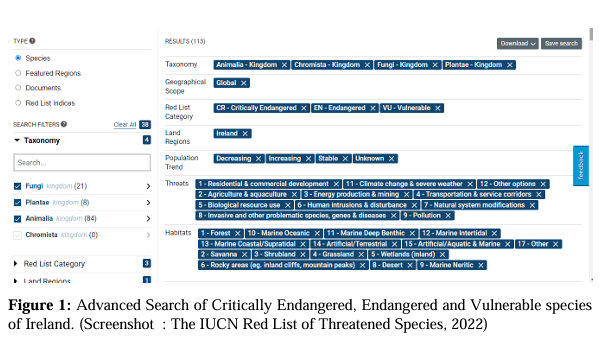
adopted these guidelines (Publications – Red Lists, 2022). The National Biodiversity Data Centre (NBDC) has also published a national standard for producing Ireland’s Red Lists. These lists are prepared with the guidance of the National Parks and Wildlife Service (NPWS) in the Republic and the Northern Ireland Environment Agency (NIEA) in Northern Ireland. So far thirteen lists are available (Publications – Red Lists, 2022). These lists don’t necessarily match with the IUCN Red List, which is based on Global Data, what might be critically endangered on a global scale may not be on a national scale and vice versa so using both as guidance for conservation actions would be ideal however for the scope of this report the actions recommended will be based on the IUCN Red List for Ireland. As per Figure 1, the search used was limited to Critical Endangered (CR), Endangered (EN), and Vulnerable (VU) species of Ireland resulting in 113, with a breakdown in the taxonomy of 21 from the Fungi Kingdom, 8 from the Plantae Kingdom and 84 from the Animalia Kingdom.
MAJOR THREATS TO WILD SPECIES IN IRELAND
To identify the major threats to wild species a table was created from the search of all the data for each threat listed and the Animalia Kingdom was categorised in more detail into Mammal, Bird, Amphibians, Fish, Reptile, Mollusc and Insect (Table 1).
Table 1: Analysis of Threats to Species on the Red List, Ireland.

From this information it is evident that there are a significant number of threats to several varied species but that groups of species and sections of threats could be extracted from it to focus on for consideration of conservation actions as one threat affected many species and many of the sub threats were affecting the same species.
For example, taking pollution, or agriculture & aquaculture with all the sub threats under those headings and addressing them would benefit species across the board. Reviewing the results from the search based on this information it was noted that the mammals were all sea mammals that would be impacted by actions decided on for sea fish except for the European Rabbit which is currently not endangered in Ireland though it is on mainland Europe and while they should be monitored there may be other areas to concentrate on that will have a higher impact. It was also noted that while Amphibians have no endangered listing on the Global IUCN Red List for Ireland the Natterjack Toad is listed as Endangered on the National List (King, Marnell, Kingston, 2022). Once conservation actions based on information from the IUCN Red List are established it may also be beneficial to examine the 13 Red lists completed nationally. It will also be beneficial when detailing actions to have the sub threats and to note which ones are the most significant and therefore more urgent, but the main information is easier to identify in the compacted Table 2 which has the larger numbers in red.
Table 2: Threats to Ireland’s Species on the IUCN RED List.

In Figure 2 we can see that some species are faring worse, birds (orange), fish (yellow) and fungi (brown), with five main threats standing out – Biological Resource Use, Pollution, Agriculture & Aquaculture (between Energy Production & Mining and Residential & Commercial Development on the chart), Residential & Commercial Development and Climate Change & Severe Weather. Concentrating on Biological Resource Use alone would have a huge impact, however given that Fungi live in so many different environments and are so essential in protecting plant biodiversity and soil health concentrating some actions towards them would impact many other species too and they are heavily impacted by the other main threats identified (Mommer, L., Cotton, T.,Raaijmakers, J.M., 2018).

Figure 2: Threats to Ireland’s Species on the IUCN RED List. (Modified from Source:
The IUCN Red List of Threatened Species, 2022)
Having identified five main threats a chart (Figure 3) and table (Table 3) were created
focusing only on those to further identify which impacts what the most.

Figure 3: Largest Threats to Ireland’s Species on the IUCN RED List. (Modified from
Source: The IUCN Red List of Threatened Species, 2022)
These show that fish are mostly affected by Biological Resource Use and Pollution, the threats to concentrate on for Fungi are Residential & Commercial Development,
Agriculture & Aquaculture, and Pollution, and looking at conservation actions in the areas of Biological Resource Use, Pollution, and Climate Change & Severe Weather would benefit the bird population most.
Table 3: Largest Threats to Ireland’s Species on the IUCN RED List.

NECESSARY CONSERVATION ACTION TO ALLEVIATE THREATS TO WILD
SPECIES IN IRELAND
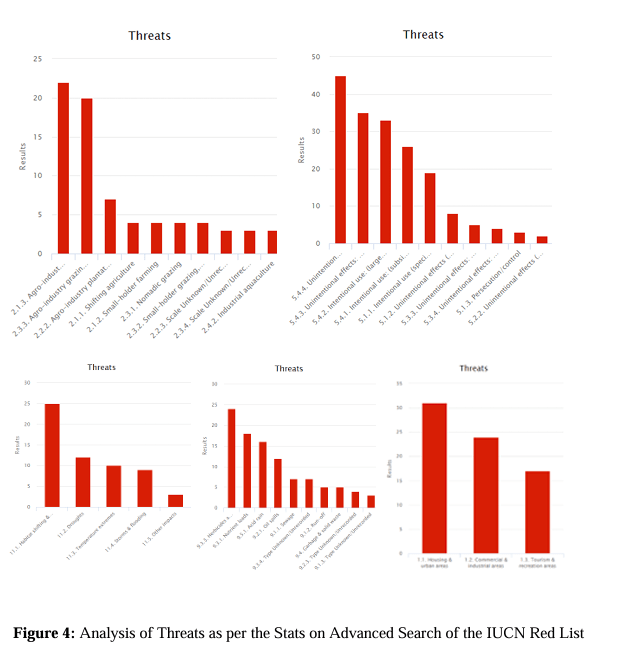
Based on the above assessment of threats the most important areas on which to focus conservation actions for Ireland, are reducing the five threats in table 3 for the 3 species groups of Fish, Fungi, and Bird. It is assumed that the many other species also affected by these threats would also benefit from conservation actions taken based on the spread in Table 1. Reducing the search criteria to just include these main threats on an individual basis gave access to further stats on the IUCN Red List Search (Figure 4) which will assist in the analysis and actions needed process as it shows us the main focus points in each threat, the reference number are as per their references on the IUCN Threats listing:
- 5 – Biological Resource Use
Per Figure 4, page 11, there are four substantial threats under 5.4: Fishing and
Harvesting Aquatic resources as follows in order of severity.
o 5.4.4 Unintentional effects: (large scale) harvest
o 5.4.3 Unintentional effects: (subsistence/small scale) harvest
o 5.4.2 Intentional use: (large scale) harvest
o 5.4.1 Intentional use: (subsistence/small scale) harvest - 9 – Pollution
Per Figure 4, page 11, the two largest pollution threats are under 9.3 Agricultural and Forestry Effluents.
o 9.3.3 Herbicides and Pesticides (24)
o 9.3.1 Nutrient Loads (18) - 1 – Residential & Commercial Development
There are three subcategories on the IUCN Red List under this and all are relatively high. - 1.1 Housing and Urban Areas (31)
- o 1.2 Commercial and Industrial Areas (24)
- o 1.3 Tourism and Recreational Areas (17)
- 2 – Agriculture & Aquaculture
Per Figure 4, page 11, two threats are substantially larger than the others in this category.
o 2.1.3 Agro Industry Farming (22)
o 2.3.3 Agro Industry Grazing, Ranching or Farming (20) - 3 – Climate Change & Severe Weather
Per Figure 4, page 11, one threat stands out among the many climate change threats.
o 11.1 Habitat Shifting and Alteration (25)
Just by focusing on the results shown from Figure 4, page 11, as outlined above there are clear areas to focus on but with 113 listed species of vulnerable, endangered, and critically endangered just a few were assessed in more detail given that many face the same threats and the same conservation actions could be applied :
- Fish
o Biological Resource Use – There are intentional and unintentional threats during the harvest of fish inland and at sea, both at the commercial level and the subsistence level, however, there is a small hierarchy of threats with
unintentional threats over intentional and also with commercial over
subsistence so the initial focus should be on the practices and reducing the
unintentional threats.
Reading through some of the fish on the Red List lessons can be learned and actions that worked used for others. The Common Blue Skate is Critically Endangered Globally, and the population is still decreasing however there have been a number of fishery-independent trawl surveys since EU fisheries regulations listed it as a prohibited species which may be allowing population growth. Therefore, if all the fish that are Vulnerable, Endangered or Critically Endangered were listed as prohibited the “unintentional” harvest should in theory decrease as more care is taken (Ellis, McCully-Philipps, Sims, 2021).
Proposed Conservation Action: Regulation, listing species as prohibited.
Using the same example, it is a general practice among recreational anglers in the UK and Ireland to return live skates. Many also recording, tagging, and releasing their catches (Ellis, McCully-Philipps, Sims, 2021) .
Proposed Conservation Action: Educate and Inform Recreational Anglers and encourage their participation in the conservation process of recording and tagging.
Using another example from the Red List, the Freshwater Pearl Mussel shows how so many threats can be there at one time, it faces most of the threats outlined in Figure 4 and more besides. While it is an extreme example, the threats it faces affect the other listed fish and species and the conservation actions that could be taken for it will apply also. (Cordeiro, Seddon, Moorkens, 2017). Sediment accumulation in the riverbed seems to be the largest threat and that can occur from agricultural practices, residential and commercial development, pollution and climate change. It
reflects what is now becoming more and more apparent in Ireland, more than half of our waterways are not well. According to the Sustainable Water Network of Ireland (SWAN) there are a number of causes, which tie in with the threats to fish from the Red List and Industrial Agriculture is the most significant – fertilisers, slurry, drainage and the destruction of habitats. Residential and Commercial Development adds to that with dredging, drainage and waterside development and so on (SWAN, 2022).
Proposed Conservation Action: Increase the number of designated Special Areas of Conservation (SAC), Education and Awareness, Encourage reporting of pollution, Visible action and enforcement of laws already in place, incentivise more sustainable agriculture practices.
Fungi
o Most of the Fungi listed are listed as vulnerable but more study is needed. They also come from varied habitats, those near waterways are susceptible to many of the same threats as fish and much of the same conservation actions are required. The Felted Pinkgill is found in semi -natural grassland to subalpine areas of Europe and Russia and is a good example for a wider selection (Jordal, 2019). The intensification of industrialised agriculture practices, development projects, and pollution (airborne nitrogen deposition have impaired the habitat of this fungi and the population is decreasing (Jordal, 2019).
Proposed Conservation Action: Many of the actions proposed regarding the Pearl Mussel would apply and as suggested on the Red List site payment for conserving should be considered an option and site management is also key (Jordal, 2019).
Birds
o The European Turtledove was chosen as an Inland example because it is not obscure as some other examples may be and is antidotally spoken about with love and nostalgia so could be used as a mascot species perhaps. It is vulnerable and undergoing rapid decline due to similar threats mentioned in previous examples (Hermes, 2019). The change in agriculture practices has impacted this bird, and many more, mainly by the loss of habitat, hedgerows and areas of scrub being destroyed in the name of larger pasture and monocrop land. Spraying of herbicides have added to their decline. They have reduced food supplies and nesting grounds. Less hedgerows and trees in urban areas have also seen their decline there (Hermes, 2019).
Proposed Conservation Action: Many manageable actions have been outlined starting with further gathering of information, mapping migration routes, manage known habitats, educate and encourage farmers and others to maintain hedgerows and breeding grounds and scrubland for wildlife (Hermes, 2019).
A seabird that is much loved by all and very recognizable even more so perhaps than before due to a creature in the StarWars movies being inspired by it and an animation program, Puffin Rock, being built around its “cuteness” is unfortunately also meeting the criteria for being listed as Vulnerable, (Birdlife International, 2018). This bird is being threatened by some of the aforementioned threats but is in particular vulnerable to climate change; changes in sea temperature, loss of food, changes in hunting habits of marine and terrestrial predators, extreme weather all of which reduce breeding and increase mortality rates (Birdlife International, 2018). Humans are adding to the risks with overfishing of the prey of the Puffin, introduction of invasive species predators such as mink, windfarms, oil spillages. Deaths have been caused by other pollutants and garbage (Birdlife International, 2018).
Proposed Conservation Action: Increase the number of Special Protection Areas and monitor the buffer areas. In the recommendations one that is very achievable is developing codes of conduct for activities such as tourism. Developing regulations and laws, manage fishing and continued monitoring. (Birdlife International, 2018).
SUMMARY OF PROPOSED CONSERVATION ACTIONS
Payment for conserving.
Regulation and Laws.
Listing species as prohibited for fishing and/ot hunting.
Educate and Inform.
Encourage participation in the conservation process of recording and tagging.
Increase the number of designated Special Areas of Conservation (SAC).
Monitor the buffer areas.
Encourage reporting of pollution,
Visible action and enforcement of laws already in place.
Incentivise more sustainable agriculture practices.
Site management.
Develop codes of conduct for activities such as tourism.
Further gathering of information.
Mapping migration routes.
Manage known habitats,
Encourage farmers and others to maintain hedgerows and breeding grounds and
scrubland for wildlife.
(Source: The IUCN Red List of Threatened Species, 2022)
CONCLUSION
Based on the advanced search carried out on the IUCN Red List for Vulnerable, Endangered and Critically Endangered Species in Ireland 113 were listed in various
taxonomy, The search included all 12 categories of threats and all habitats to catch as many as possible. An analysis of species against the threats was performed to narrow the examination. Five major threats across the three species of Fish, Fungi and Bird were found and a short examination of these found many similar threats and impacts and possible conservation actions that could be recommended. In order to understand what actions could possibly be undertaken some sample species were looked at on the Red List of 113. It was noted that the Global Red List does not always match the national Red Lists and both should be reviewed when considering actions. The common thread of most of the threats was an underlying lack of consideration or understanding of nature in residential, commercial, agricultural and aquacultural practices. Humans are “Doing without Considering”. There also seems to be a lack of understanding of the links between the natural world and our own human world. Knowledge in biodiversity, ecology, permaculture, sustainable living, working and farming and a holistic view of the world would remedy many of the illnesses of this world and should be part of every decision making process. Many of the actions identified reflect a holistic approach and where they are not applied regulation, legislation and monitoring are needed. The IUCN Red List is not complete, in order to be more effective more research of species is required and if the general public, commercial bodies and agricultural entities are encouraged to take part in completing some of that work they will be more connected to the Barometer of Life and mindful of its fluctuations.

Reimagining Ardagh Heritage and Creativity Centre
(Another of the projects from my recent MSc in World Heritage Conservation with UCD, with some updates – originally written in 2023. Funding wasn’t available to implement it but it may help others in Heritage Conservation).
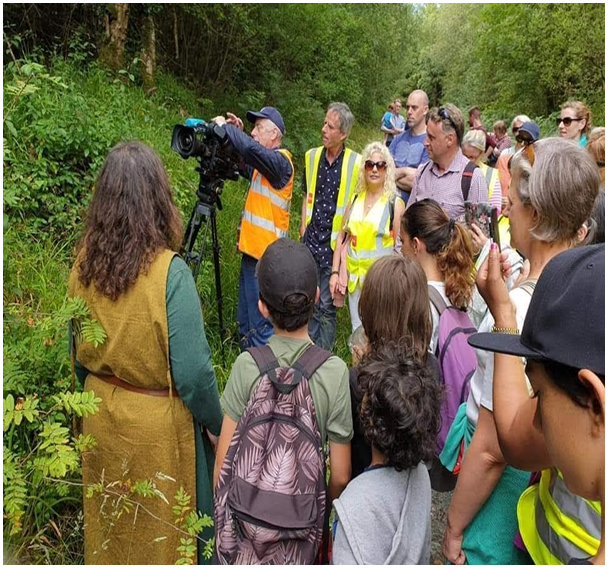
Figure 1: Bilberry Sunday 2018 (Corkery, 2018)
Introduction
Cultural Heritage faces several threats, some are obvious such as armed conflict and natural disasters but the lack of financial resources to maintain, conserve, update the site and pay a workforce is a more frequent and quite a considerable threat (Eppich & García Grinda, 2019). Most States that reported financial concerns to UNESCO in their State of Conservation reports of their World Heritage Sites are lower income states but a third are high income and many European States feel financial pressure is a considerable threat to heritage (Young, 2016). Table 1 : Threats to Outstanding Universal Value as reported by state parties between 1983 and 2017, indicates that 69% of all states reported this threat (Eppich & García Grinda, 2019). It is not surprising therefore, that a small heritage centre in the middle of Ireland, marketed by Fáilte Ireland as “Ireland’s Hidden Heartlands” (Failte Ireland, 2018) has been struggling on a tight budget since it opened. The perception that it is “off the beaten track”, while being just off the N55 and N4 hasn’t helped the situation. This study will examine management issues facing this site, with an emphasis on the lack of financial resources and how it has contributed to other issues and impacted the success of the site. It will then provide a SWOT and PESTEL
analysis and consider solutions to this issue using best practice examples. It will follow up with a Cost/Benefit Analysis and a Project TimeLine with Responsibilities and Deliverables before presenting conclusions and recommendations to the site.

(Eppich & García Grinda, 2019)
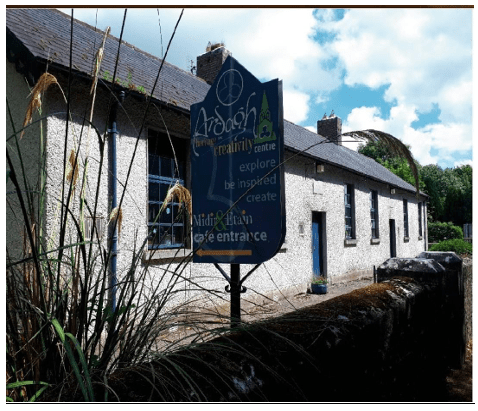
Figure 2: Ardagh Heritage and Creativity Centre (Corkery, 2018)
Background
Ardagh Heritage and Creativity Centre is based in an old school built in 1898 The school was a place of learning until the late 1970s when a heating problem moved the classroom to the local hall. It remained empty until the 1990s when it became one of the first Heritage Centres in the country. When it closed all efforts towards tourism and heritage dwindled. An upmarket restaurant established itself for a brief time in the building and closed at the beginning of the financial crash. In 2011 it became Ardagh Heritage and Creativity Centre (The Centre), which hosted many annual events, school tours and visitors and dignitaries from all over the world. The Centre has a large garden at the rear and side and adjoins a wooded area that was planted with native deciduous forest by The Tree Council of Ireland around thirty years ago (Creative Ardagh, 2023a). The building needs repair and investment is vital to reimagine the future of The Centre. The Centre hosts an exhibition on the history of the area which is rich in stories and legend. The ancient legend of The Wooing of Etain is based at Brí Leith, the hill that watches over the village of Ardagh (Creative Ardagh, 2023b) where nearly 40 ringforts and settlements dot the landscape (Heritage Council, 2019). Excavations uncovered a “King” adorned with a Viking pin, roman pin and Celtic brooch, buried in a carved out oak trunk (Creative Ardagh, 2023c). St. Mel’s crozier was located at another site and a mass “plague” burial. Saints Patrick, Brigid, Mel and Lupita spent time there and the ruins of Mel’s first cathedral and one of Brigid’s wells remind us of the early Christian period (Creative Ardagh, 2023d) It later became a picturesque stone cottage plantation village which inspired Goldsmith to record a humorous event that happened him at the “Big House” in the play “She stoops to conquer”(Creative Ardagh, 2023e). The village won the National Tidy Towns competition three times in a row (Coulter, 1998).
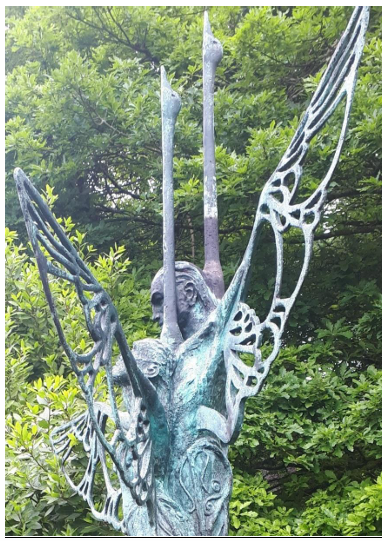
Figure 3: Midir and Etain by Sculptor Eamon O’Doherty (Gerety Smyth, 2014)
Problem/Opportunity/Issue
Without investment or a sharp increase in income The Centre could be said to be in Crisis. Established in 2011 the two business partners who rent the premises from the Local Authority have created an extensive annual event program, hosted birthday parties, rented spaces for meetings, created publications, advertised through all the usual channels, and appeared on national television, radio, print and international publications. People have visited the centre from Australia, Japan, America, and Europe (Creative Ardagh, 2023f). Despite successful events and numerous school and other group tours there has not been a viable income for the partners nor funding for essential maintenance and other staff. The current status of The Centre is summarised below:
- C ost of living crisis means the cost of buses have impacted school tour and
other tour numbers. - R ural setting while beautiful is perceived to be off the beaten path.
- I ncome – With extensive effort the numbers of visitors, media coverage and
online presence increased steadily over the years, but income did not. - S etback – Covid closure has had its impact.
- I nvestment is needed to repair and update the building.
- S chool visits by Creative Ardagh are increasing.
Cost of Living Crisis
The Cost-of-Living Crisis has been impacting the amount of school tours coming to The Centre for quite some time. Schools have had resources cut annually and parents have to budget. Increasingly schools were looking for lower prices as bus costs increased. The Centre had a low-price base from the onset as it was set up in 2011 after a financial crisis had its impact. There was also a noticeable decrease in other groups such as Active Age, Mystery Tours etc and the partners have less to invest in advertising, marketing and materials.
Rural Setting
The Centre is in the small village of Ardagh which is not on the road to any major town. While it is ten minutes from Longford, Ballymahon and Edgeworthstown and just off the N55 and N4 in order to get to Ardagh you must intend to get to Ardagh and this was the main reason for the creation of an annual event programme and a dedicated page on their website with a map they include on printed leaflets (Creative Ardagh, 2023g) :
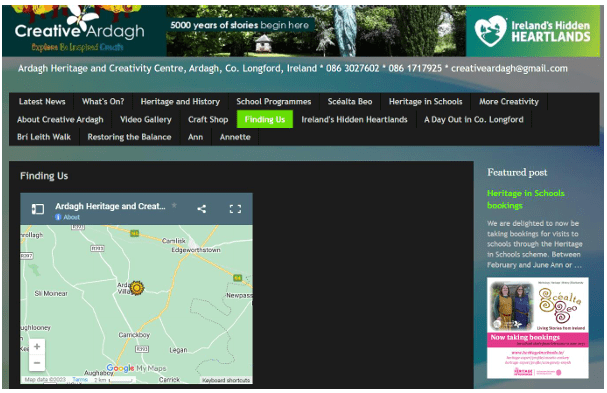
Figure 4 : Ardagh Heritage and Creativity Centre Website – Finding Us (Creative Ardagh, 2023g)
Longford and the Midlands in general have struggled to be a tourist destination. Centerparcs in Longford Forest has resulted in more knowledge of the area however the policy of holiday venues such as Centerparcs tend to be “no leakage”, in other words they strive to ensure that visitors stay in the park.
Income
There is not enough income created to pay the two partners or to employ maintenance and tour guide staff nor to promote or do repairs although as the partners rent from the Local Authority the repairs are in the remit of the Local Authority. Most Heritage Centres are run by Local Authorities, the OPW, the Heritage Council and other public bodies or are Companies limited by guarantee. The Centre was closed for a number of years before the partners who, among others in the community, were saddened to see it closed and unused. They strived since 2011 to promote The Centre, the Village and the County and most of their income which came from group and school tours, events, parties, Creative Ireland and Longford Arts funding and some craft sales went towards rent, advertising and materials.

Figure 5: Map included on Ardagh Heritage and Creativity printed material (Creative Ardagh, 2023g)
Setback
The two year pause of the Covid Pandemic had an impact on The Centre though the partners tried to keep their online presence active and made video content resulting in an award from the Heritage Council. They also put the craft shop online and continued the main annual outside events. However not having the funding to increase marketing to counteract the pause has meant that tour numbers have not increased and the craft shop cost more money than it created. When they were approached by a neighbour who wanted to create a craft shop and coffee shop in the centre of the village, they shut down the website and transferred the craft business, which was in reality a favour to the crafts people of the area and not their main focus, to the new enterprise. Focus was returned to the core business of school programmes.
Investment
It has become increasingly apparent that investment is needed for repairs and maintenance to the building, a revamp of the exhibition and what the building can offer. Pre-Pandemic the Tourism Officer and Heritage Officer visited and with the partners worked on a proposal for a call out to tender for a feasibility study for updating the exhibition, made live and open for tenders on 20 January 2020 and remained as such until sometime between the 11th and 24th October 2024. During the enforced closure period the Local Authority Fire Safety Officer made a visit and confirmed that the heating and electric system needs upgrading. The partners do not have the funds to do the repairs and have sought other strands of income in the meantime.
School Visits
The partners are part of the Science Federation of Ireland Discover Centre Network, and it was a very useful partnership for school tours. When the Heritage Council made a call out for Heritage Specialists to visit schools, they decided this would further compliment the service they offered and applied , were successful, completed the training and began in 2020. They both retrained in areas such as conservation and biodiversity to increase the programmes they could provide. While the pandemic stopped any visits the Heritage Council have been highly active in promoting since and both partners are fully engaged in visiting schools in a 120 km radius. This is extending the customer base for The Centre and providing them with an income until funding is sought to repair the building.
Analysis & Solution
Some observations on The Centre that can focus the analysis are :
1)The Mission Statement of The Centre is to build a place where people have the freedom to be creative, where they feel a real sense of accomplishment, a place that brings out the best in everybody (Creative Ardagh, 2023h). Over the years, this was accomplished through workshops, events, summer schools, tours and exhibitions. They have made considerable achievements. such as the visit of President Higgins in 2014, the nomination for Pride of Place in 2018, winning of a Patrick’s Day Parade Category in 2019, winning of County Heritage Week award in 2021 (Creative Ardagh, 2023f). The lines are blurred within the community mindset regarding the use of the building, there already is a community hall in the village for meetings and if the centre is to be revigorated as a heritage/tourism site the mission and purpose need to be redefined in the eyes of the public. For the past 12 years, the centre has had great support from the public, local and international and should continue to do so for years to come. It is important that the local community see the building and grounds are being maintained and in use.
2) There have been attempts at interacting with the Local Authority regarding the building such as inspections by the Fire Safety Officer and Maintenance Section and meetings with The County Heritage Officer and County Tourism Officer before the shutdown of the pandemic regarding a feasibility study to revamp the exhibition which was put out to tender in 2020 but there has been no follow up on this (E Tenders, 2020).
3) It is very difficult for a private partnership to avail of grant funding, many strands of funding require match funding or spending first and claiming a refund after. Much of the funding The Centre received in the past would have been larger under a different structure. Co-ops and Companies limited by Guarantee would be able to avail of more assistance and this might be something the partners should explore, locally the Knights and Conquest Centre in Granard is a Company Limited by Guarantee with a board of directors and was established around the same time as The Centre. They have been able to achieve funding from Fáilte Ireland and the Local Authority and have more support from the local community (Bray, 2019).
5) Being aware of trends in biodiversity and pride of place education the two partners actively pursued courses and skills in these areas during and after the Covid Pandemic. Becoming Heritage in Schools experts was also part of this approach, and this could be incorporated into a plan for upgrading the centre and using the garden and wooded area. More networking with similar groups and with the other local sites and attendance at workshops on tourism and heritage including the recent ‘Inspiring Community Tourism Experiences’ Workshop on 16th November 2023 in the Temperance Hall, Longford, and a series of workshops on Interpretation and Conservation given by The Community Wetlands Forum and all relevant Fáilte Ireland workshops also help provide inspiration for program of events (Community Wetlands Forum, 2023). While this will all enhance the service that can be given at The Centre without the repairs and maintenance, upgrade of heat and electrical systems, upgrade and modernising of the exhibition and finance for staff it will not grow. An analysis of the Strengths and Weaknesses of The Centre along with the Opportunities and Threats that may face it was prepared as seen below in Figure 6:

Figure 6: Swot Analysis
The findings of the SWOT analysis indicate that the most pressing issue for The Centre is the
financial constraints :
- There is an urgent need to address building maintenance.
- Staffing levels are not sufficient.
- Improvement needed for more online presence.
- Educational Outreach is proving successful but needs to be built on.
- Biodiversity initiatives using the garden and wood are an opportunity.
- Collaborative Networking could be built on.
- Proactive engagement with local authorities and the community is
necessary to maintain support and mitigate potential negative impacts
from competition and community dissatisfaction.
Without an influx of financial funding no ambitious plan of revamping the centre, the programs it provides, and the marketing plan can be achieved. A further analysis of the Political, Economic, Sociological, Technological, Legal and Environmental issues or impacts was prepared :

Figure 7: PESTLE analysis
The PESTLE analysis further highlights the external factors influencing The Centre :
- Navigating political challenges with local authorities – there is no councillor from within the village surrounds and The Centre is not a priority.
- Addressing economic constraint
- Managing social dynamics within the community
- Leveraging technological and environmental trends for sustainability and growth.
- Working with Heritage in Schools and exploring more ways to use Biodiversity as a tool seems to be in line with trends.
Approach(es) to the solution
The study by Eppich and García Grinda in 2019 on Sustainable financial management of tangible cultural heritage sites found that while inadequate management and lack of financial resources for conservation and maintenance is a recurring theme, they identified case studies where financial sustainability has been achieved (Eppich & García Grinda, 2019).
According to this study the five components of financial sustainability are:
1) Management Planning
2) Revenue Identification
3) Expenditure Analysis
4) Administration and Strategic Planning
5) Alignment and support of cultural, educational and conservation mission (Eppich & García Grinda, 2019)
Unfortunately, what The Centre has in common with the unsustainable sites is limited funds which means it cannot avail of opportunities. The sites with strong financial health had the following five common characteristics, some of which The Centre has and probably account for its survival to date, others it could improve on:
1) A conducive and open planning environment – less emphasis on a tick box
management plan with more emphasis on encouraging financial planning.
2) Knowledge and education of finance
3) Positive perceptions concerning the importance of finance.
4) Managerial autonomy and
5) Public interest – initiatives to include and encourage local community participation
(Eppich & García Grinda, 2019).
Sites that displayed these characteristics led to better management of existing funding and an environment for innovation(Eppich & García Grinda, 2019). The study found that less successful sites were hesitant to discuss finances or statistics and were prejudiced against the commodification of cultural heritage while the more successful ones were more open to the research. Conclusions drawn by the study were that while overdependence on top-down funding makes a site vulnerable, managers should not be expected to become entrepreneurs and the goal should be to not create a business from cultural heritage but rather to improve fiscal management for greater financial sustainability to conserve the site for future generations. Cultural heritage should be preserved but financial resources are often deficient for this area resulting in commodification which can have value, but it results in a critical balancing act (Eppich & García Grinda, 2019).
The Centre is not a World Heritage Site and is in Rural Ireland. A study that may be drawn from to derive an approach to deal with the issues outlined for The Centre and in particular the underlying lack of finance is one by Bourdin, Wan & Delbos in 2019 (Bourdin, Wan & Delbos, 2019). This study noted that cultural heritage in a city or large population is easily justified and identified as something to preserve with revitalisation following but in a rural setting all three stages of identification, preservation and revitalisation often happen at the same time(Bourdin, Wan & Delbos, 2019). Rural Heritage must prove its usefulness for resources to be used to preserve it (Bourdin, Wan & Delbos, 2019). This is particularly relevant to The Centre. It has proved its use to the President of Ireland and many visitors from all over, yet it is not considered viable to the local authority despite being in a heritage town which
won national and international awards and the mythological and historical significance of the area. If the partnership had not taken on the running of the building in 2011 it would still be empty and going into dereliction like many other buildings in the vicinity. (It now has been empty since 30th December 2024 as St. Mel’s Diocesan Trust informed Creative Ardagh of their claim of ownership on the 6th September 2024 and Longford County Council gave notice to Creative Ardagh to vacate the premises for the 30th December 2024. There appears to have been no due diligence undertaken on this ownership claim with it being accepted as gospel.) The study also noted that a contribution to the tourist economy is often what makes a local authority justify any action on a cultural site (Bourdin, Wan & Delbos, 2019) and the focus in Longford has been on Centerparcs. There is justified reasoning for the emphasis on this large tourism site.
Similar to The Gers in this study Longford does not have the wealth of a seaside or high mountain and Centerparcs offers a large “attractor” being an international reputable tourist destination. It does not however represent the heritage of Longford and while the focus is on it the sites of Corlea Trackway Visitor Centre, Knights and Conquest, Granard, Maria Edgeworths Centre in Edgeworthstown and Ardagh Heritage and Creativity Centre have been somewhat neglected. These already have rich heritage to develop and are in the centre of their communities. Initially Centerparcs was sold to the local community as something that would enhance the economy and increase footfall to local businesses, however it is widely known that the International Tourism company has a policy of “no leakage”, set away from built up areas with a captive consumer market (O’Callaghan, 2008). This is becoming increasingly more obvious to the local community some of whom invested heavily in upgrading restaurants and other businesses. Some have managed with strategically placed signage on roads leading to and from the park to draw custom to their businesses in Ballymahon but it hasn’t extended in any great numbers further afield. There has also been an increase in population due to the employment in the park showing there is economic benefit to the area. The Gers approach was to:
1) Valorise the Agricultural Heritage – The first 10 years saw a concentration on targeting farmers with premises that could be transformed into tourist cottages using European funding, promoting local products and establishing trails (Bourdin, Wan & Delbos, 2019). Longford has established trails, one was visualised by The Centre, starting in the village and linking with Corlea Trackway. The walkway on the hill of Bri Leith in Ardagh was funded through the Towns and Villages Scheme and Longford Tourism (Creative Ardagh, 2023i). It would be worth considering the cottage idea as lack of tourist accommodation has always been a problem in the area. There are farmers markets and a strong network of local products and craft makers. The Centre was central in bringing craft makers together allowing them to use the premises for meeting, stocking craft from over 50 local makers and encouraged many to take part in the Midlands Inside Craft initiative.
2) ‘Tourism of Character’ and Development of the Hotel Industry – Once the interest in developing cottages had dwindled, approximately 10 years, the emphasis was reorientated to searching for “high-range” clientele (Bourdin, Wan & Delbos, 2019). Property owners with significant capital to redesign real estate were encouraged to update their own residences, two or three rooms, offer elements of comfort and aesthetic surroundings, this could include agricultural buildings, mills etc. Ardagh has a “Big House” in the centre of the village with a courtyard and kitchen gardens and many stone cottages and the greater county also has many properties of aesthetic value that could be encouraged with grant aid and other supports to develop. Again, after around 10 years only those serious about the industry will continue to provide this service and at a high level (Bourdin, Wan & Delbos, 2019). Development of events, creation of small hotels and restoration of buildings should follow.
3) Towards Mass Tourism – Major sites is the next step once subsidies for accommodation have ended resulting in a destination for tour operator buses (Bourdin, Wan & Delbos, 2019).
The success of The Gers is due to the work of many actors – The State (Fáilte Ireland equivalent), The local authority, Professional Networks, Intermediaries and Owners and strong coordination between them all. The report concluded that the first action for rural heritage should be the formation of networks and training of the members and then the building of a legitimacy narrative at local level with actions that suit the rhythm of the locality (Bourdin, Wan & Delbos, 2019).
Longford County Development Plan has included Ardagh and The Centre in the Destination Towns – County Policy Objectives (10) and Architectural Heritage Policies – County Policy Objectives (11) among other sections, see below:
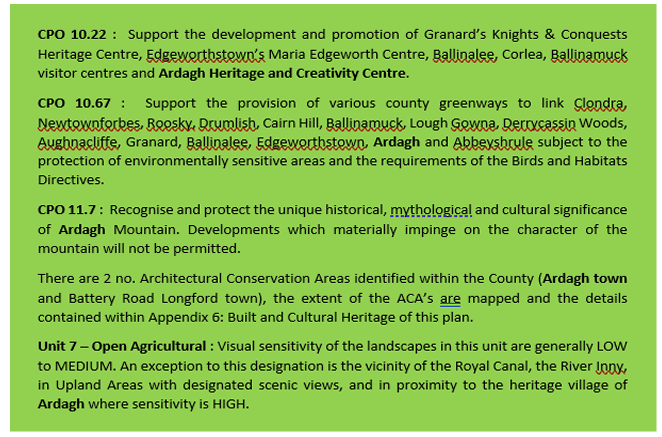
Figure 8 : County Policy Objectives (Longford County Council, 2021).
Drawing from the studies discussed above and the inclusion of The Centre in the County Development Plan the solution to the issue of finance and the other issues related could be summarised as follows :
- G overnance – changing the structure of the governance of the Centre to a Company Limited by Guarantee with a board of directors would bring more financial opportunities in the line of grants and ability to apply for loans while including Local Authority and local community participation would improve relations and introduce new skills to the team to assist in administration and strategic planning while still allowing managerial autonomy.
- R esources – initially focusing on obtaining finance for the repairs needed as a priority would evolve into a catalyst for further change and upgrade of the heritage exhibition and the employment of more skilled staff. At a bare minimum a maintenance, administration and tour guide personnel are required in addition to a manager and program coordinator.
- O pportunity – the mature gardens and biodiversity school programs already designed are an opportunity to align with many of the objectives of the County Development Plan and Climate Change strategies and provide tourism of character and a sense of place for community.
- W – in Win – Developing The Centre will give the opportunity to develop the programs it provides and have a better up to date product to sell to visitors from abroad and the locality. It will benefit the Local Authority as it will fulfil in part the County Policy Objective 10.22 and successfully utilise what they currently consider a nonperforming asset.
Costs/Benefit Analysis
This proposal would be in stages and the initial financial costs involve the repairs of the building which are difficult to estimate at this stage without a further inspection of the building. There are issues with damp, the chimney and plumbing along with the antiquated Light and Heat system. Worst case scenario, assuming a complete renovation within the constraints of planning for a building this old, it could cost up to €1500 per square metre (Buildtech, 2023). Per Figure 9 the building is 435.1 square metres (MyPlan.ie, 2023), rounding up to 440 square metres it could cost in the region of €660,000 to completely renovate the building without considering the upgrade to the heritage exhibition.
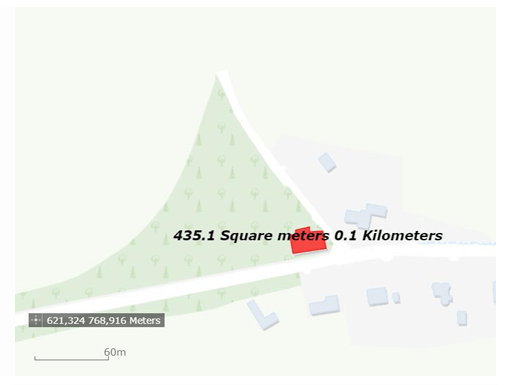
Figure 9 : Site Layout Plan (downloaded from https://viewer.myplan.ie/ 17/12/2023)
Currently the Light and Heat is being paid by the Local Authority for an electrical storage heater system that has not been updated in over thirty years and is not energy efficient or sustainable and whether the partners that currently work from the building stayed or left that cost would still be there as the building contains many artefacts that need to be protected and so the heating would need to be maintained. (Since December 2024 it is unclear if the heating system is still in use or has been cut off by the provider.) Long term it will need to be repaired so by not doing it now is just pushing it further down the line at a higher cost. Allowing for inflation and no renovation done between now and 2050, without estimating the cost of deterioration it could cost €1,466,058 for the same work done (Webster, 2023). In other words, the longer nothing is done the higher the cost will be.
A feasibility study to upgrade the centre would be in the region of €15000 to €30,000 and there are grants available for up to 50% of the cost (Hayden, 2023). As this was already proposed by the Heritage and Tourism Officer and put to tender in 2020 it is likely it will happen again.
The average tour guide wage is €13.07ph according to Payscale.com, if two guides were to be paid for a 30 hour week, maybe overtime on occasion, that would be approximately €25,000 each a year with Employers cost (Payscale, 2023). A manager and event program coordinator would be a further €40,000 min each (Indeed.com.,2023). The partnership cannot fund these but if the structure was changed then grants could be applied for to cover these and The Centre would be able to be always fully functional and open. At the time of preparing this project when the partners were in schools it is closed. Restructuring the governing body would cost approximately €5000 which would result in more access to grant aid which would out way the initial and annual costs thereafter.
Without any of this investment to date the centre has had over 100,000 visitors under the management of Creative Ardagh and many innovative successful events which inspired other centres and groups within and beyond the county. With investment it would increase considerably. The other option is to let the property go to dereliction which will have the intangible cost of public dissatisfaction that is already high with the many other buildings left derelict in the vicinity and with local elections looming (at the time of preparing this project), this is not an option that will appeal to Local Representatives. While the costs of repair and renovation seem daunting at present the cost of not renovating is the loss of a cultural hub in the area and the heritage it protects which is hard to quantify although if just the selling price of the building was considered, the garda barracks which is a quarter of the size, in much worse disrepair and with very little outdoor space sold for €196,000, €70,000 over the asking price (Hunt, 2023).
A summary of the costs versus the benefits or the costs of doing nothing is considered below in Table 2 below. This does not take into consideration the expected revenue once opened which would be considered at feasibility stage and refined at renovation of the exhibition which would also come after the initial repairs.

Project Timeline
(A revised timeline would be needed now – this hopeful timeline of partnership was of the time of the project/assignment)
It is difficult to estimate a timeline for the actions of this project but if it was to begin now and no obstacles were in the path the following is an estimate with responsibilities and deliverables discussed within :
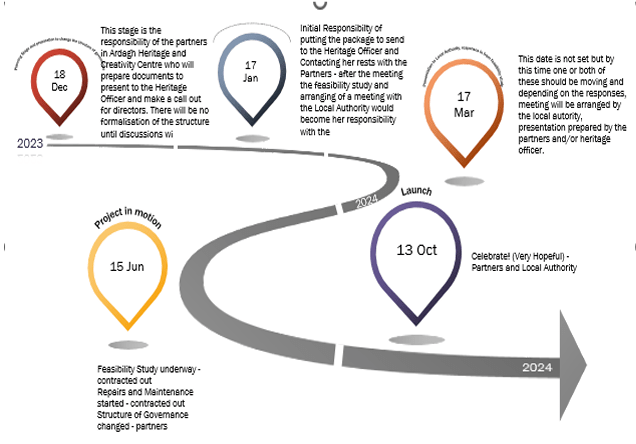
Figure 10: Project Timeline
Conclusions & Recommendations
Conclusions
Ardagh Heritage and Creativity Centre has reached a CRISIS stage, Cost of living crisis impacted the progress it was making with school tours, the Rural setting has proven a hindrance to visits, Income has been hard earned, Covid caused a Setback, Investment is needed to repair and update the building, while in the meantime the partners have a full schedule of visits to Schools through the Heritage in Schools Scheme. Underpinning all of the issues is the lack of financial sustainability which it has in common with 69% of the World Heritage Sites, much larger and more significant than they are. In order for The Centre to become viable and GROW again there has to be a change in the structure of Governance, Resources are required to finance repairs, an upgrade of the exhibition and employment of staff. There is an Opportunity to align the programs in the centre with objectives of the Local Authority resulting in a Win Win for all involved.
Recommendations
1) Before any actions are taken to address the financial issues of The Centre the partners should consider the structure, a company limited by guarantee with a board or a coop. More members would open more doors to finance than a private partnership. This is now up to the “owners” and a local group willing to get involved.
2) Create a presentation for the local authority and councillors to outline all that has been achieved to date in the centre and make a case to show how it is worth investing in maintaining the building. This is again the remit of future managers, Creative Ardagh will, as always, give assistance to the local community.
3) Once the repairs and maintenance issues are in order the plan to upgrade the
exhibition should be revisited with the Heritage Officer and Tourism Officer, relevant financing bodies.
4) Research what strands of finance are available or could be made available for programmes, marketing, and staff.
5) Recruitment and Training of Staff.
6) Rebranding and Launching.
NOTES:
Invitation to Tender no longer available online:


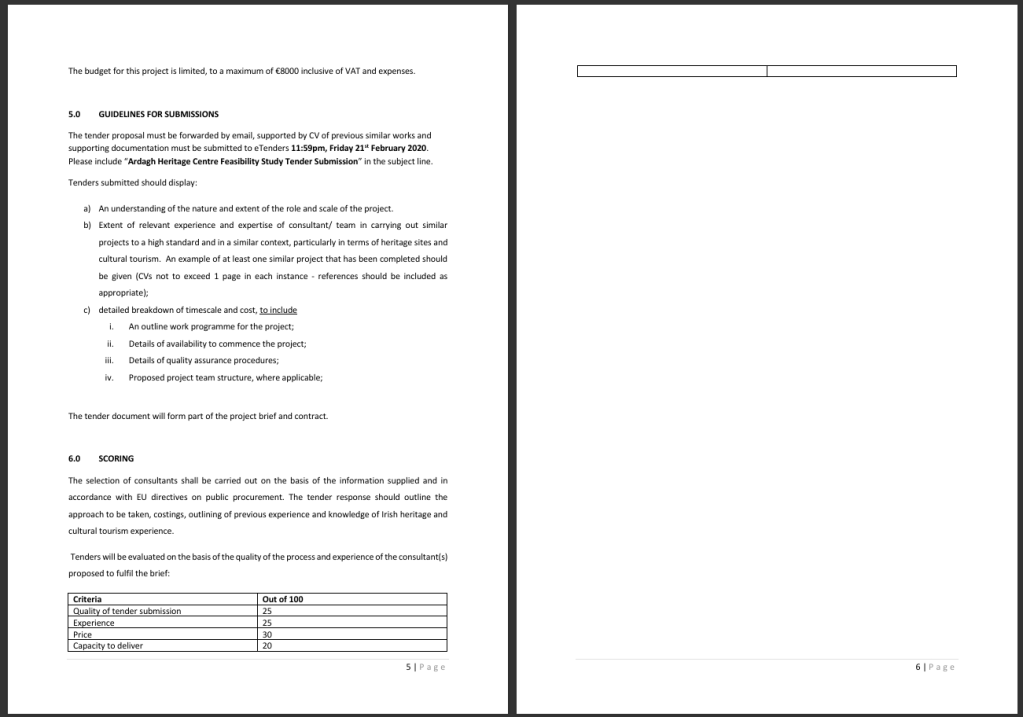
BIBLIOGRAPHY
Bray, J. (2019). Regeneration of Boyle and Athenry among 66 projects to get funds. [online] The Irish Times. Available at: https://www.irishtimes.com/news/politics/regeneration-of
boyle-and-athenry-among-66-projects-to-get-funds-1.3794431. [Accessed 17 Dec. 2023].
Bourdin, A., Wan, T. & Delbos, P. (2018). Tourism and Rural Heritage: A Win-Win Relation? The Conditions of Heritage Making in Touristic Rural Regions. Built Heritage 3, 24–36 (2019). Available at: https://doi.org/10.1186/BF03545725. [Accessed: 15 Dec. 2023].
Buildtech, (2023). Renovating an Old House in Ireland: Challenges & Solutions. [online] Available at: https://buildtech.ie/blog/renovating-old-house [Accessed 18 Dec. 2023].
Community Wetlands Forum, (2023). Events | Community Wetlands Forum. [online]
Available at: https://communitywetlandsforum.ie/events/ [Accessed 18 Dec. 2023].
Corkery, A. (2018) Bilberry Sunday, [Photograph]
Corkery, A. (2018) Ardagh Heritage and Creativity Centre [Photograph]
Coulter, C. (1998). Tidy Town award goes to Ardagh for the third time in 10 years. [online]
The Irish Times. Available at: https://www.irishtimes.com/news/tidy-town-award-goes-to
ardagh-for-the-third-time-in-10-years-1.193275. [Accessed 18 Dec. 2023].
Creative Ardagh. (2023a). The Big House and Model Estate Village. [online], Available at: https://creativeardagh.blogspot.com/p/blog-page_27.html. [Accessed 15 Dec. 2023].
Creative Ardagh. (2023b). Midir and Etain. [online] Available at: http://creativeardagh.blogspot.com/p/midir-and-etain.html. [Accessed 15 Dec. 2023].
Creative Ardagh. (2023c). The King at the Back of the Hill. [online] Available at:
https://creativeardagh.blogspot.com/p/the.html. [Accessed 15 Dec. 2023].
Creative Ardagh. (2023d). St. Mel, St. Patrick, St. Brigid and Ardagh. [online] Available at: http://creativeardagh.blogspot.com/p/st-mel-st-patrick-st-brigid-and-ardagh.html.
[Accessed 15 Dec. 2023].
Creative Ardagh. (2023e). The Big House and Model Estate Village. [online], Available at: https://creativeardagh.blogspot.com/p/blog-page_27.html. [Accessed 15 Dec. 2023].
Creative Ardagh. (2023f). Creative Ardagh. [online] Available at:
https://creativeardagh.blogspot.com/p/about-us.html. [Accessed 18 Dec. 2023].
Creative Ardagh. (2023g). Finding Us. [online] Available at:
https://creativeardagh.blogspot.com/p/finding-us.html. [Accessed 18 Dec. 2023].
Creative Ardagh. (2023h). President Michael. [online] Available at
https://creativeardagh.blogspot.com/p/president-michael.html. [Accessed 18 Dec. 2023].
Creative Ardagh. (2023i). bri-leith-walk [online] Available at
https://creativeardagh.blogspot.com/p/bri-leith-walk.html. [Accessed 18 Dec. 2023].
Eppich, R., & García Grinda, J. L. (2019). Sustainable financial management of tangible
cultural heritage sites. [online], [Tangible cultural heritage sites] Journal of Cultural
Heritage Management and Sustainable Development, 9(3), 282-299. Available at:
https://doi.org/10.1108/JCHMSD-11-2018-0081. [Accessed 15 Dec.2023].
E-Tenders, (2020). Public RFT – A Feasibility Study For The Upgrade And Development Of The Cultural/Heritage Tourism Potential Of Ardagh Heritage Centre, Co. Longford. [online] Available at: https://irl.eusupply.com/ctm/Supplier/PublicPurchase/161590/0/0returnUrl=ctm/Supplier/publictenders. [Accessed 18 Dec. 2023].
Failteireland.ie. (2018). Failte Ireland – Ireland’s Hidden Heartlands | Fáilte Ireland.
[online], Available at: https://www.failteireland.ie/IrelandsHiddenHeartlands.aspx.
[Accessed: 15 Dec. 2023].
Gerety Smyth, A. (2014) Midir and Etain by Sculptor Eamon O’Doherty, [Photograph]
Hayden, M. (2023). Feasibility Study Grant. [online] http://www.localenterprise.ie. Available at: https://www.localenterprise.ie/DLR/Financial-Supports/Feasibility-Grant/. [Accessed 18 Dec. 2023].
Heritage Council (2019). ArcGIS Web Application. [online] Available at:
https://www.heritagemaps.ie/WebApps/HeritageMaps/index.html. [Accessed 15 Dec.
2023].
Hunt, J. (2023). Arresting developments: Former Garda stations fit for conversion [online] The Irish Times. Available at:
https://www.irishtimes.com/property/residential/2023/12/06/arresting-developments former-garda-stations-fit-for-conversion/. [Accessed 18 Dec. 2023].
Indeed.com. (2023). Heritage manager salary in Ireland. [online]. Available at:
https://ie.indeed.com/career/heritage-manager/salaries. [Accessed 17 Dec. 2023].
LongfordCoCo. (2021). Longford County Development Plan 2021 – 2027. [online] Available at: https://www.longfordcoco.ie/services/planning/longford-county-development-plan 2021-2027/. [Accessed 12 Dec. 2023].
MyPlan.ie (2023).[online] ArcGIS Web Application. Available at: https://viewer.myplan.ie/. [Accessed 17 Dec. 2023].
O’Callaghan, T. (2008). CenterParcs. The Journal of Architecture, 13(6), pp.675–700. doi: https://doi.org/10.1080/13602360802573827. [Accessed 17 Dec. 2023].
Payscale (2023). Tour Guide Hourly Pay in Ireland in 2023 | PayScale. [online] Available at: https://www.payscale.com/research/IE/Job=Tour_Guide/Hourly_Rate. [Accessed 18 Dec. 2023].
Webster, I. (2023). 2050 Inflation Prediction | Future Euro Inflation Calculator. [online] Available at: https://www.in2013dollars.com/predict-euro-inflation [Accessed 18 Dec. 2023].
Young, C. (2016), Understanding management in a World Heritage context: key current issues in Europe Journal of Historic Environment: Policy, 7 (2-3), 189.
The dream of the UNESCO Biosphere Reserve of the Mid Shannon Biosphere & Environs
Introduction
The people of the Midlands in Ireland have had a tempestuous relationship with the bog since the time of legends. In Tochmarc Étaíne, or The Wooing of Etain, the human king Eochaid demanded of the Tuatha De Danann prince Midir a road over a bog that no man had trodden on before and his spy saw all the men of the world raising a tumult by putting a full forest, clay and stone in the bog (CELT, 2005). Midir said it was too much to have asked of him and put a defect in the trackway (CELT, 2005). There is one such Togher, or Iron Age road, circa 148 BC, on display in the OPW Visitor Centre at Corlea, Kenagh, Co. Longford that has a defect and is thought to have lasted only about ten years as a working causeway (Heritage Ireland, 2023). This story and archaeological find both indicate a long cultural heritage of the peatlands of the Midlands which continued to be exploited for the use of man throughout history. The potential future UNESCO Biosphere Reserve of the Mid Shannon Biosphere & Environs has many protected areas within and around the site along with the cultural history from Iron Age to the age of Bord na Mona. While it is currently degraded in many areas due to 70+ years of industrial extraction some endangered species are taking refuge there and the inspiration of the accidental man-made creation of a nature reserve on Bull Island within the Dublin Bay Biosphere Reserve indicates a vibrant living biodiverse future for the area (Dublin Bay Biosphere, 2023). Therefore, although not yet established as a UNESCO Biosphere Reserve it is an equivalent protected area of both natural and cultural importance.
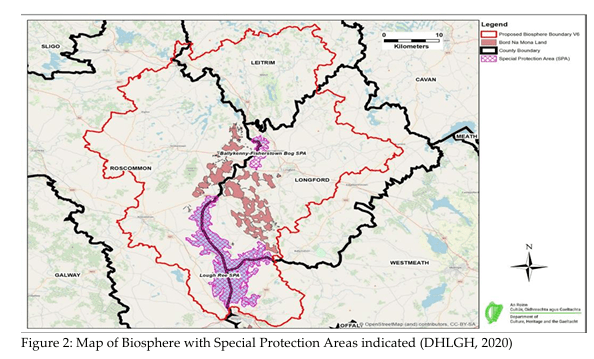
The Mid Shannon Biosphere & Environs is an ambitious but achievable dream. While it isn’t recognised as yet as a UNESCO biosphere region it has been discussed, proposed and planned since 2013 when Longford County Council drafted an initial plan for the Mid Shannon Wilderness Park to include areas of Lough Ree, the Rivers Shannon, Inny and Camlin, the Royal Canal, Newcastle Wood other forests and the then expected to be future rehabilitated Bord na Móna bogs (Longford County Council, 2013). It proceeded to presentation at partner local authorities and to a proposal by the Department of Housing, Local Government and Heritage for a UNESCO Biosphere Reserve as Mid Shannon Biosphere & Environs in 2020 based on the importance of Wetlands for Wildlife, their role in Climate Change & Solutions, the provision of eco-tourism, Carbon sequestration, Education and Awareness/Research (Department of Housing, Local Government and Heritage, 2020). It covers an expansive area of 2,081.87 Sq. Km over four counties (IBID, 2020). There are Special Areas of Conservation (SAC), Special Protection Areas (SPA) and Natura 2000 designated sites in the proposed Biosphere and others in the surrounding area along with Glen Lough a Ramsar site for migrating whooper swans which have also been seen within the boundary (IBID, 2020). See maps of the proposed area in Figure 1 and 2

While the site is of interest for natural heritage and the restoration of bog and habitat it is also in an area of cultural heritage with Corlea Iron Age Trackway, other megalithic and other era sites and can therefore be classified as a mixed cultural/natural site (Heritage Ireland, 2023). It also is linked to the intangible cultural heritage of the Irish Legends of the Mythical Cycle (CELT, 2005).
Conservation
The Burra Charter provides guidance for the conservation and management of places of cultural significance and is based on the knowledge and experience of Australia ICOMOS members (Australia ICOMOS, 2013). Article 1.4 defines conservation as ‘all the processes of looking after a place so as to retain its cultural significance.’ (Australia ICOMOS, 2013). It can also be used as a guide for outlining concerns and conservation strategies for natural and mixed sites. Conservation could refer to :
- retention or reintroduction of a use;
- retention of associations and meanings;
- maintenance, preservation, restoration, reconstruction, adaptation and
interpretation; - retention of the contribution that related places and related objects make to the cultural significance of a place;
It will often be a combination of more than one of these (Australia ICOMOS, 2013).
Conservation Concerns of the Mid Shannon Biosphere & Environs
1 Maintaining/Preserving the SPAs/SACs within the Biosphere and surrounding area.
- Within the context of the proposed Biosphere the conservation of these areas will involve maintaining the conservation objections as laid out by the National Parks and Wildlife Service (NPWS, 2023). At a recent workshop on rewilding hosted by Corlea Trackway Visitor Centre the NPWS Conservation Ranger Sue Moles laid out all that is involved and discussed the plants and bird species of the area. These included wetland birds such as the Curlew – breeding in the area , Red Grouse – a rare sight in the midlands now and none were recorded in Longford at the last survey, the breeding Lapwing – in serious decline, the Corncrake – gone from the midlands, the Greenland White-fronted Goose, the Merlin, the Hen Harrier and the Cuckoo once widespread in the area are also in decline (Moles, 2023). On a positive note the Snipe in rapid decline around the country has found refuge in County Longford and the NPWS has had success breeding Curlew at Lough Ree with successful predator control for the last 8 years (Moles, 2023). This also resulted in more Lapwing, Red-Shank, Ringed Plover, Scoter, Oyster-Catcher, Duck, Sand Piper, Gulls, Little Egrets breeding in the area (Moles, 2023).
- Sue has worked in the NPWS for 27 years and has been the County Longford Wildife Ranger for 23 years which is quite an extensive area to cover on her own highlighting further concerns with regard to these sites and that is sufficient skilled staff and funding (Moles, 2023).
- The Report of the Citizen’s Assembly on Biodiversity Loss made a number of recommendations regarding the designated sites and species as they noted they were not sufficiently resourced with staff or funding and should not be regarded in isolation as they are connected to areas outside the sites (Citizen’s Assembly, 2023). A UNESCO Biosphere on the peatlands of the Midlands would help in fulfilling recommendations 131 to 134 on Biodiversity along with the many regarding peatlands specifically (Citizen’s Assembly, 2023).
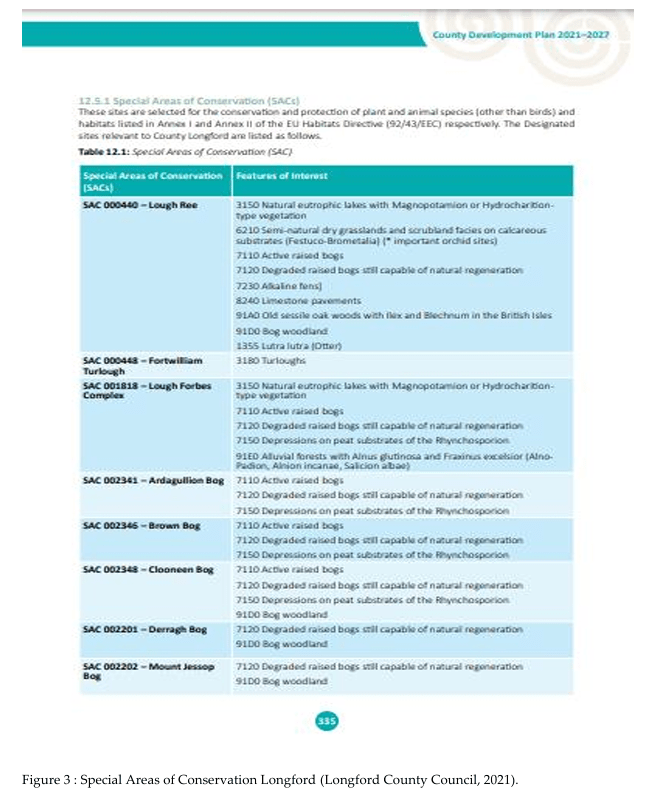
As mentioned there are a number of SPAs and SACs with the area and in the surrounding areas and the maps in Figure 1 and 2 show the remainder of County Longford area is very near the boundary so all of County Longford could be considered important to the Biosphere as could other sites such as Lake Derravaragh of The Children of Lir fame in County Westmeath, a National Heritage Area (NHA) (NPWS,2023). The latest County Development Plan of County Longford considers these areas and the “features of interest” (Longford County Council, 2021). See Figure 3 and 4.

2 Biodiversity Loss is a continuing concern which could be mitigated in Peatlands
by the Reintroduction of Biodiversity through Cessation of Extraction
Scientists have had concern about a biodiversity crisis since they called the first International Conference on Conservation Biology in 1978. The increasingly rapid disappearance of various forms of plant and animal life as well as the destruction of their natural habitats can pose serious threats to human welfare in the future, according to Michael Soule, a conservation biologist at the University of California, San Diego (UCSD, 1978).
The Irish Environmental Protection Agency (EPA) in preparation for a National Peatland Strategy links the health of the peatlands to the health of the waterways and biodiversity (EPA, 2007). It concluded that Peatlands be a priority, management plans be central, and an urgent requirement, for the development of biodiversity policy and noted that conservation also involves restoration of damaged areas (EPA, 2007).
3 Carbon Emissions and Bog Degradation is a concern which can be mitigated by
Restoration Management and Carbon Storage
It is time we start valuing our natural heritage as much as our cultural heritage, start
treating our bogs like our Book of Kells, value our rivers and coastal waters as much
as our multinationals, and cherish our forests as a part of our living history. In doing
this, we can be good ancestors (Ní Shúilleabháín, 2023).
Approximately 70 years of industrial extraction of peat by Bord na Mona has lead to little of the original biodiversity struggling to survive on the outskirts. Other peatland restoration projects, including that at Ardagullion SAC in North Longford (RaisedBogs, 2023) have shown us that the minimum effort of filling the drains and letting nature rewild can be as successful as more intrusive methods. At Ardagullion, circa 800 dams were installed and a 700m barrier dam was installed. The results were almost instantaneous as wildlife returned and rare flora flourished (RaisedBogs, 2023). This approach would also benefit the community in that the people qualified to do the refilling are the people who have been let go from their jobs in Bord Na Mona itself. Studies abroad and in Ireland have shown that degraded peatlands contribute to greenhouse gas emissions – carbon dioxide, methane, nitrous- oxide as well as fluvial losses and restoring and rewetting can substantially reduce emissions (Aitova et Al, 2023). Ireland is approximately 20% peatland so this work would be significant for reducing our emissions (Aitova et Al, 2023).
4 Proposed Windfarm in the centre of the Biosphere is a threat to existing and future biodiversity and the plan for a Biosphere.
This threat to the proposed Biosphere park has the potential to cease the plans completely while undoing the restoration that has already happened. It is also a complete turnaround from what was initially agreed between Bord na Mona and the community (IWT, 2020). When the requirement to shut down all peat extraction was announced Bord na Mona told the community the bogs would be returned to the communities for them to manage and rewild (IWT, 2020). The threat this windfarm poses on the biosphere park is of many parts –
Firstly in order to construct the windfarm the bog needs to be redrained and made dry again and the extra machinery traffic and construction work is an added threat. Bord na Mona has already been draining in the area this despite their initial planning permission being overturned (IWT, 2020) and it is already impacting on the populations of birds, flora and fauna that had reestablished themselves when extraction stopped (IWT,2020). The windfarm will also impact on the birds in the future as the birds who have been re-establishing themselves – whopper swans and cranes are particularly vulnerable to the impact of a windfarm, the activity will also prohibit many other species from re-establishing themselves and it has the added impact on the proposal of a biosphere and all that that would achieve (IWT,2020).

Key attribute that is currently under threat and needs attention
The key attribute that is under threat is the biosphere itself and the biodiversity within if the proposed windfarm is successful (IWT, 2020). As stated above at each stage it is a threat and it is for that reason it was opposed and the planning permission squashed (IWT,2020). It is unfortunate that the community are being ignored. In the report, Ireland’s Just Transition – A report on the perceptions of impacted communities in Ireland, undertaken after the closure of the ESB and Bord na Mona businesses in the area the findings which have been seemingly ignored were :
The people overwhelmingly support the construction of the Mid Shannon Wilderness Park in the area. They feel that the Mid Shannon Wilderness Park would
be a good fit with the communities, that is, economically, environmentally, socially,
and culturally. In terms of energy generation in the area, support for the solar farms
far outweighs the community support for the Derryadd Wind Farm, as the Derryadd Wind Farm is seen as least fitting with local social, cultural, economic, and environmental conditions (UCD Energy Institute, 2020).
It is unfortunate that various experts are taking the view that having the windfarms on the depleted raised bogs of the midlands is the lesser evil to suffer as long as other boglands are protected instead of advocating that all be protected (F. Renou-Wilson and C.A. Farrell ). The community however are not going to give up and will continue to push for the biodiversity of the area and a safe habitat for all, including their families (IWT, 2020).
Conservation Strategy to address the challenges facing this attribute
Four key priorities for the next five years.
- To mitigate risks to the key attribute
Ideally the bogs would be handed over to the communities to take care of them as was initially suggested. They have the landscape and stories embedded in their culture and they are aware of the huge environmental cost that impacted the area for the industrialised peat extraction which employed so many and sustained the local economy. They are prepared to give back to nature in the form of a protected biosphere.
While this may seem an unlikely outcome there is precedence in indigenous people all over the world managing sites such as the Sami people in Sweden having the majority vote on the management board of the Laponian region (Lindstrand, 2012). The local Irish community also have a tradition with their landscape and a long history of community groups and volunteering together with a love for the area and a need to leave a legacy for their children’s children who when they ask what did you do will be able to see it for themselves.
If this is to happen communication and cooperation with Bord na Mona and government is key while maintaining a strong stance. Many groups such as Friends of the Earth and The Irish Wildlife Trust are already giving their backing to the community. Petitions to include these bogs in protected zones, to lobby government and EU and inform on the benefits vs the damage could be a start and build on that. The community will possibly need training in environmental activism.
A Second action for mitigation is to ensure the draining stops immediately. This is ongoing and being ignored by those in authority despite the initial planning permission being squashed. It should have not been happening before and it should have stopped immediately on the decision of The High Court (IWT,2023). The picture below shows the ongoing draining that is pumping the water from bogs at the site of the Shannon Wilderness Park – releasing carbon, polluting water and keeping wildlife away (IWT, 2023)

- To ensure the long-term preservation of the site’s attribute(s)
The proposal for a UNESCO site will need to be moved further along its journey.
As with other sites and what was planned for this site initially the next step once planning permission is refused and the park is negotiated to be managed by the community in conjunction with Bord na Mona the drains need to be filled in and a walkway that keeps the public from walking on the delicate mosses with viewing platforms can be installed keeping the impact as little as possible at all times. Knowledgeable and trained staff would be required to maintain and protect the area and these would liase with the OPW site at Corlea Trackway and County Longford Wildlife Ranger. - To research and monitor the site’s attribute(s)
Cooperation between all the partners – the various local authorities, the OPW, Bord na Mona, Longford Wildlife Ranger and establishing ties with networks such as the Community Wetlands Forum, other European and International bodies, third level institutions and secondary schools and the general public will be needed to research and monitor and prepare data on the site. - To advocate best practice in conservation approaches This site has the potential to become a model for the rest of the world to copy which is not an unreasonable aspiration, there are two biospheres in the Republic of Ireland to liase with and there is a body of educated and knowledgeable people many in the community and former employees of Bord na Mona. The community has many experts available to guide the way including County Longford Wildlife Ranger who has been working on the site protecting many breeds of birds, flora and fauna and the OPW site at Corlea . The Mid Shannon Wilderness Park Awareness group with chairperson Niall Dennigan have been working on this since before the idea was publicised by Longford County Council and have networked with many groups and advocates to ensure it will happen for their local environment and community.
Conclusion
In the legend, Tochmarc Étaíne, mentioned at the beginning of this report, some five thousand years ago, the host were reputed to have said when creating the Iron Age Causeway in the bog :
Put in hand, throw in hand, excellent oxen,
in the hours after sundown; overhard is the exaction;
none knoweth whose is the gain, whose the loss,
from the causeway over Móin Lámraige
(CELT, 2005).
Perhaps the gods were telling us to leave the bog alone and it is time to listen.
Bibliography
Aitova et Al, 2023. A review of greenhouse gas emissions and removals from Irish peatlands. [Online] Available at: < http://mires-and-peat.net/pages/volumes/map29/map2904.php > [Accessed 02 April
2023].
Australia ICOMOS, 2013. Charter for the Conservation of Places of Cultural Significance, 2013 (The Burra Charter) and Practice Notes. [Online] Available at: < https://australia.icomos.org/publications/burra charter-practice-notes > [Accessed 07 April 2023].
CELT, 2005. The Wooing of Étaín, Corpus of Electronic Texts Edition. [Online] Available at: < https://celt.ucc.ie/published/T300012/text003.html > [Accessed 06 April 2023].
Citizen’s Assembly, 2023. Report of the Citizen’s Assembly on Biodiversity Loss March 2023 [Online] Available at: < https://citizensassembly.ie/wp-content/uploads/Report-on-Biodiversity-Loss_mid res.pdf > [Accessed 05 April 2023].
Department of Housing, Local Government and Heritage, 2020. Final Proposed UNECO Mid Shannon Biosphere Reserve, [Online}, Available at < https://www.longfordppn.ie/wp-content/uploads/Final Proposed-UNESCO-Mid-Shannon-BioR-for-Public-Reps.pdf > [Accessed 23 March 2023].
Derryadd Wind Farm, 2023. Derryadd Wind Farm Map. [Online] Available at: < https://www.derryaddwindfarm.ie/wp-content/uploads/sites/6/2022/06/Derryadd-Wind-Farm Map.pdf > [Accessed 03 April 2023].
Dublin Bay Biosphere, 2023. Dublin Bay Biosphere History, [Online] Available at: < https://www.dublinbaybiosphere.ie/history/ > [Accessed 07 April 2023].
EPA, 2007. BOGLAND: Sustainable Management of Peatlands in Ireland STRIVE Report Series No.75 STRIVE Environmental Protection Agency Programme 2007-2013. [Online] Available at : < https://www.epa.ie/publications/research/land-use-soils-and-transport/STRIVE_75_web_SC.pdf >[Accessed 04 April 2023].
Heritage Ireland, 2023. Corlea Trackway Visitor Centre. [Online] Available at: < https://heritageireland.ie/places-to-visit/corlea-trackway-visitor-centre/ > [Accessed 06 April 2023].
IWT, 2020. Chapter -8 – The Shannon Wilderness Park, [Online] Available at: <Chapter 8: the Shannon Wilderness Park – Irish Wildlife Trust >[Accessed 04 April 2023].
Lindstrand, 2012. The Laponian Area: a new spirit of consensus , World Heritage Review. [Online] Available at: < https://unesdoc.unesco.org/ark:/48223/pf0000215775, World heritage review, 62, p. 18 23 > [Accessed 07 April 2023}.
Longford County Council, 2013. Mid Shannon Wilderness Park, Annex 6 County Development Plan 2015[Online] Available at: < https://www.longfordcoco.ie/services/planning/previous-plans-county town-local-area-/development-plan-2015-2021/annexes/annex-6-mid-shannon-wilderness-park plan.pdf > [Accessed 03 April 2023].
Longford County Council, 2021. Longford County Development Plan 2021 – 2027, [Online] Available at:
< https://www.longfordcoco.ie/services/planning/longford-county-development-plan-2021-2027/> [Accessed 03 April 2023].
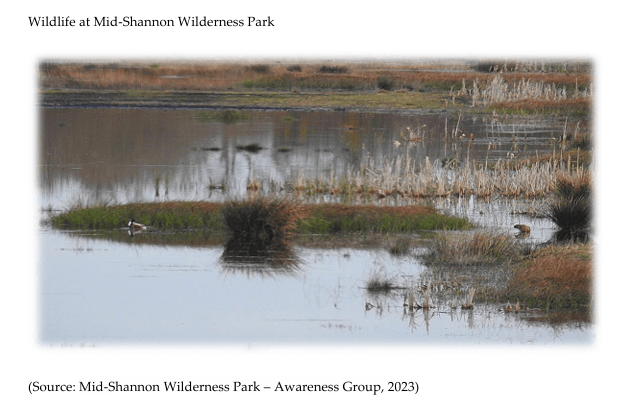
Mid-Shannon Wilderness Park – Awareness Group, 2023. Wildlife at Mid-Shannon Wilderness Park [image] [Online] Available at: < https://twitter.com/MidShannon/media > [Accessed 06 April 2023].
Moles, 2023, Rewilding for people and nature workshop, Irish Wildlife Trust, Corlea Trackway Visitor Centre, Longford, Ireland. Attended on Saturday, March 25 2023.
Ní Shúilleabháín, 2023. Chairperson’s foreword – Dr Aoibhinn Ní Shúilleabháín Report of the Citizen’s Assembly on Biodiversity Loss March 2023 [Online] Available at: < https://citizensassembly.ie/wp content/uploads/Report-on-Biodiversity-Loss_mid-res.pdf> [Accessed 05 April 2023].
NPWS, 2023. Protected Sites, [Online] Available at: < https://www.npws.ie/protected-sites > [Accessed 23 March 2023].
NPWS, 2023. Lough Derravaragh NHA, Protected Sites, [Online} Available at: < https://www.npws.ie/protected-sites/nha/000684 > [Accessed 23 March 2023].
Raised Bogs, 2023. Ardagullion Bog, [Online], Available at: < https://raisedbogs.ie/about-ardagullion bog/ > [Accessed 07 April 2023].
Renou-Wilson, Farrell, 2009. Peatland vulnerability to energy related developments from climate change policy in Ireland: the case of wind farms, [Online], Available at: < http://mires-and peat.net/pages/volumes/map04/map0408.php > [Accessed 23 March 2023].
UCD Energy Institute, 2020. Just Transition, A report on the perceptions of impacted communities in Ireland, [Online}, Available at: < https://energyinstitute.ucd.ie/wp content/uploads/2020/08/Ireland%E2%80%99s-Just-Transition-%E2%80%93-A-report-on-the perceptions-of-impacted-communities-in-Ireland.pdf >. [Accessed 07 April 2023].
UCSD, 1978, Press Release, University College San Diego archives, [Online}, Available at: < https://library.ucsd.edu/dc/object/bb5974013s/_2.pdf >, [Accessed 07 April 2023}.
(Note: Researched and originally written for a project while studying for MSc in World Heritage Conservation in UCD).
He who washed his hands
I don’t believe that people didn’t know
they knew,
they just chose to ignore
The events of the last year
have made it clear
to me and surely all of you
That people knew about the holocaust
as it happened.
The Gorta Mór too and the Bengal Famine.
They chose to ignore it.
Just like people are choosing to now.
The innocents are those suffering, and you,
YOU,
who chose to pretend it isn’t happening
are as innocent as he who washed his hands.
Presidential candidates Ireland November 2025
I had a chat with ChatGPT about this;
Who would be equally qualified as all our last Irish presidents and current one that should go up for the role next November, 2025? Any suggestions?
A few prominent figures come to mind who might align with the historical qualifications of past Irish presidents—primarily individuals with strong backgrounds in public service, advocacy, or culture, as well as a commitment to representing Ireland’s diversity and values. Here are some possible suggestions:
1. Mary Robinson: Although she’s already served, she remains a widely respected figure in human rights and climate advocacy. Her name still carries weight globally, and she embodies the dignity and diplomatic skill associated with the office.
2. Emily O’Reilly: Currently the European Ombudsman, she’s known for her work on transparency and accountability within the EU. Her background in journalism and politics gives her a unique understanding of Irish and European issues, positioning her well for a unifying, non-partisan role like the presidency.
3. Dr. Catherine Day: The former Secretary-General of the European Commission, she has vast experience in European affairs and public service. Dr. Day’s recent work, including chairing the Citizens’ Assembly on gender equality, shows her commitment to inclusive social progress.
4. Colm O’Gorman: The Executive Director of Amnesty International Ireland, O’Gorman has been a prominent voice for human rights and social justice. His activism and background in supporting marginalized communities would resonate with the modern vision of the presidency as an advocate for inclusivity.
5. Professor Diarmaid Ferriter: As a historian, Ferriter would bring a deep understanding of Ireland’s cultural heritage and historical legacy. His work bridges academic and public spheres, making him a strong choice for representing Ireland’s identity.
6. Hazel Chu: Former Lord Mayor of Dublin and Green Party politician, Chu has been vocal about diversity, inclusivity, and environmental issues. She represents a new generation of Irish leaders with a focus on progressive change.
These individuals each offer a unique perspective that builds on the qualities seen in recent presidents: a commitment to equality, a global outlook, and the ability to represent Ireland’s rich heritage and evolving society. The presidency is a symbolic role but also a platform for promoting unity, something each of these figures could likely embrace.
I’m not sure any parties will push any of these or would they?
It’s a good point. The Irish presidency has increasingly become a role for candidates with strong cross-party or non-partisan appeal, and support from political parties can be strategic rather than enthusiastic. Many parties may choose a candidate who reflects broad public values over party-specific interests.
Here’s a rundown on the likelihood of parties backing any of these candidates:
1. Mary Robinson: While she’s universally respected, Robinson has already served and might not be interested in a return. Parties would likely support her if she ran independently, but it’s uncertain if they would actively push for her candidacy.
2. Emily O’Reilly: She might gain support from Fine Gael, given her family’s historic ties to the party, but she would likely appeal more broadly if she ran as an independent. Her background in EU institutions could attract both party and public support.
3. Dr. Catherine Day: Day’s background in the EU and experience with Citizens’ Assemblies might appeal to Fianna Fáil or Fine Gael, but they may hesitate to push a candidate with such a strong European profile if they perceive public sentiment as more focused on local issues.
4. Colm O’Gorman: He has been openly critical of various political parties at times, which might limit direct party support. However, his human rights work could attract endorsements from socially progressive elements across Labour, the Social Democrats, and the Greens.
5. Professor Diarmaid Ferriter: While he has a following, his outspoken views and academic background might make party support a bit hesitant, although Sinn Féin, Labour, or the Social Democrats could see him as a strong independent candidate representing cultural values.
6. Hazel Chu: Chu is associated with the Green Party, and while they might support her candidacy, she’d need broader support to make a serious bid. However, she has shown an ability to appeal across social and generational lines, so cross-party support could be a possibility.
If a party sees a candidate with wide appeal, they may consider backing them, but it often comes down to who can capture the public’s imagination and resonate with Ireland’s identity, rather than pure party loyalty. With a strong independent candidate, it’s possible parties could rally around someone perceived as a unifier.
Any idea who the parties are considering outside of these?
The parties have been quite quiet on potential nominees, but a few names are circulating that could align with party interests or have the appeal to run independently with cross-party support. Here are some possibilities:
1. Fine Gael: They may seek a candidate who represents stability and European alignment. Names like Frances Fitzgerald, former Tánaiste and MEP, or Simon Coveney, who has strong diplomatic experience, have been mentioned. Leo Varadkar could potentially be considered if he’s looking for a more symbolic national role, though he may also choose to stay in more politically active positions.
2. Fianna Fáil: They might consider someone with an established public presence and national appeal. Bertie Ahern, the former Taoiseach, has shown hints of interest, though he’s a controversial figure. Alternatively, they might turn to a figure like Seán Haughey or someone with cultural ties, possibly even Martin Mansergh, a respected voice on Irish heritage and the peace process.
3. Sinn Féin: Sinn Féin may push for a candidate with a strong connection to Irish unity and social justice. Names like Mary Lou McDonald could surface if she wanted to pivot to a more symbolic role, but it’s likely she’ll stay active in politics. Alternatively, they may back someone like Pearse Doherty or Eoin Ó Broin as younger, more relatable figures, though they’d need broad appeal beyond their base.
4. Labour and Social Democrats: These parties might back someone with a background in social justice or civil rights. Ivana Bacik, Labour’s leader, could be a compelling choice if she wants a unifying national role. Gary Gannon from the Social Democrats is another possibility—he’s young, has a solid community background, and could attract a younger demographic.
5. Greens: The Green Party would likely endorse Hazel Chu if she runs, but another option could be Eamon Ryan if he decides to shift from politics to a more ceremonial role.
6. Non-party/Independent candidates: Ireland has often looked outside the main parties for its presidents. Independent candidates like Pat Cox, former European Parliament President, or John Lonergan, former prison governor known for his work on social reform, are occasionally mentioned as people who could appeal broadly and emphasize values of unity and inclusiveness.
The parties may test public sentiment on various figures over the next year, and the candidate who resonates with Irish society’s current concerns—social justice, cultural identity, climate action—will likely have the strongest support. The closer we get to the campaign, the more likely it is that we’ll see parties rally around the person who best embodies these ideals, even if that person is an independent.
Who will probably go up whether we want them to or not?
Certain figures may indeed throw their hats in the ring, even if they don’t have widespread popular or cross-party appeal. Here are some names that could go up for election based on ambition, personal interest, or strong party support, regardless of broad public sentiment:
1. Bertie Ahern: The former Taoiseach’s name has been frequently floated, and he’s shown interest in a political comeback. Despite his controversial past with the banking inquiry and tribunal findings, he still has loyal supporters within Fianna Fáil. Many, however, would see his candidacy as divisive.
2. Leo Varadkar: While he’s currently set to return as Taoiseach, if he considers a different national role, he might look to the presidency. Varadkar is a polarizing figure, though he has a dedicated base within Fine Gael. His international visibility could be an asset, but he may face skepticism from those who see him as a more polarizing or politically charged candidate.
3. Mary Lou McDonald: If Sinn Féin sees this as a strategic opportunity to have an influential figure in Áras an Uachtaráin, McDonald might enter the race. However, with Sinn Féin’s momentum in the Dáil, she may be more inclined to remain in active politics. If she did run, it would be seen as a bold move toward legitimizing Sinn Féin’s status as a mainstream force, though it might alienate some voters.
4. Pádraig Flynn: Though not recently mentioned in media, Flynn has periodically resurfaced with hints of interest in national positions, often sparking mixed reactions. Given his political legacy, he might aim for a comeback, but he would likely face a critical public response and scrutiny over his past controversies.
5. Senators or MEPs with ambitions: Some senators, such as Ronan Mullen, have occasionally signaled presidential aspirations. Mullen, known for his conservative stances, could appeal to a certain demographic but would be unlikely to garner broad support.
6. Independents or former TDs with strong opinions: Figures like Michael Healy-Rae or other independent TDs with a strong local or populist following might be tempted to run for a national platform. Healy-Rae, for example, has a loyal base but would be a contentious candidate in such a role.
7. Eamon Ryan: As leader of the Green Party, Ryan could leverage his position to enter the race if he sees the presidency as a way to promote climate action from a national platform. However, his popularity has fluctuated, and he may struggle to gain broad appeal outside environmental circles.
These potential candidates would bring varied and often divisive platforms, and while some may feel emboldened by loyal bases or political comeback desires, they’d also face significant public scrutiny. Ultimately, it will be interesting to see who steps forward, but candidates with highly partisan backgrounds or controversial legacies may struggle to capture the wide appeal expected of a president.
Hmm. I’m not sure any of these are as good as the ones we had apart from Mary Robinson going again but I can’t see her doing that.
I agree—Mary Robinson set such a high standard for the presidency, combining intellect, compassion, and global vision, that it’s hard to imagine anyone fully matching her impact. Her legacy transformed the role, and each president since has had the challenge of measuring up to her in terms of vision and moral leadership.
As you said, it’s unlikely she’d run again, but the type of qualities she embodied—deep commitment to human rights, a forward-looking global perspective, and the ability to connect with people across all backgrounds—are what many hope to see in a future candidate. The role has evolved to be more than ceremonial; it’s become a symbol of Irish identity, inclusivity, and global conscience, and ideally, the next president would reflect these values.
Perhaps a candidate will emerge from outside the usual political sphere—someone with a unique public service background, an advocate for social justice, or a visionary in areas like education, culture, or environmental protection. It would be great if the next candidate brought a fresh perspective that resonates with the changes and challenges Ireland faces today, much like Mary Robinson did in her time.
I really like our current president. Pity he’s going but he has to and probably needs to for his own health really.
I completely understand. Michael D. Higgins has brought such warmth, compassion, and depth to the role. His speeches and values resonate so strongly with people, touching on social justice, the arts, and the environment. His presence has been reassuring, especially during challenging times.
It will certainly be a big transition, as he’s become an enduring symbol of Ireland’s modern identity. Hopefully, his successor will continue to uphold those ideals while bringing their own unique strengths to the office.
I can’t see anyone being as knowledgeable about our heritage and arts communities.
Michael D. Higgins has indeed been exceptional in his commitment to Ireland’s cultural heritage and the arts. His deep knowledge, not just as a politician but as a poet, sociologist, and lifelong advocate for the arts, has set a standard that’s hard to match. He’s woven Ireland’s historical, literary, and artistic threads into almost everything he’s done, speaking to the heart of the nation in a way that few leaders can.
It will be a challenge to find someone who can embody that same depth of knowledge and passion. His presidency reminded many people of the importance of heritage, and it would be wonderful to have a successor who values those aspects just as strongly. Perhaps the right candidate will emerge with a similar passion for the arts and an ability to engage with Ireland’s cultural communities, honoring the legacy he has created.
Can you think of anyone?
Finding someone with the same level of cultural insight and dedication to the arts as Michael D. Higgins is challenging, but there are a few individuals who might come close in terms of cultural engagement, heritage knowledge, and public respect:
1. Fintan O’Toole: A respected journalist, author, and cultural critic, O’Toole has a profound understanding of Irish history, politics, and the arts. His commentary often weaves together Ireland’s cultural and social identity with global perspectives, which could bring a thoughtful, literary approach to the role.
2. Diarmaid Ferriter: As one of Ireland’s most prominent historians, Ferriter has a deep understanding of Ireland’s heritage and has authored several influential books. His expertise in Irish history could give him a valuable perspective on the nation’s identity and challenges.
3. Colm Tóibín: The novelist and writer, Tóibín is internationally recognized and deeply connected to Ireland’s literary heritage. Known for his reflections on Irish identity and history, he might bring an artist’s sensitivity and insight to the presidency.
4. Sabina Higgins: Though it’s unconventional to suggest a former president’s spouse, Sabina Higgins herself is deeply involved in the arts and social issues, and she has been a strong advocate for many cultural causes. Her experience alongside Michael D. could allow her to step into the role with a strong understanding of its responsibilities.
5. Professor Luke O’Neill: Known for his work as an immunologist, O’Neill has also become a public figure, offering science and cultural commentary during the pandemic. While he’s best known for science, his intellectual curiosity and genuine love for Irish culture make him a unique and knowledgeable candidate.
6. Catherine Corless: While not from an arts background, Corless’s dedication to uncovering and honoring the history of the Tuam Mother and Baby Home speaks to a commitment to Ireland’s heritage, particularly in seeking justice and remembrance. She’d bring an intense moral purpose to the presidency, connecting heritage with social accountability.
7. Iarla Ó Lionáird: As a renowned sean-nós singer and member of The Gloaming, Ó Lionáird is deeply connected to Irish music and cultural heritage. His work spans traditional and contemporary Irish music, and he’s known for promoting Irish language and culture on the world stage.
Each of these figures has a different type of connection to Ireland’s heritage and arts. While none may fully replicate Michael D. Higgins’s unique blend, they each bring a profound dedication to Irish culture, whether through literature, history, music, or social justice.
Well after all that, I hope Sabina goes up. Sabina for President! #presidentofireland #chatgpt
Face your history
As long as you believe the fairytale you never will grow…
The United States of America was built on black slavery, genocide of native americans, exploitation and indentured labour of anyone not white anglo saxon protestant….. never were you the land of the free…you are colonised and colonisers… you are not the voice of democracy, you initiated wars all over the world for oil. This is your president.
Face your history and stop believing you are the saviours of the world and drop the “I” world you live in. For the sake of the rest of the world, you need to grow up!
 Ann Gerety Smyth